
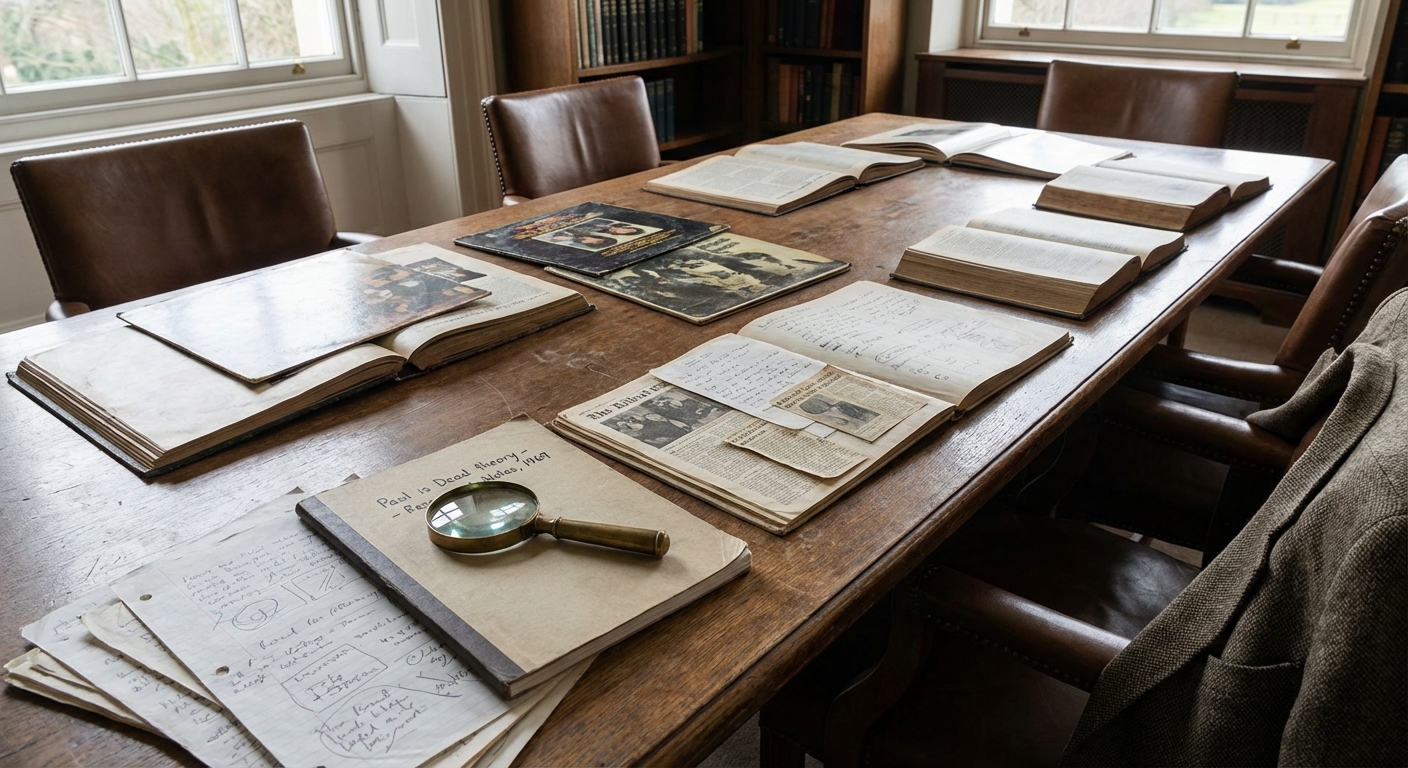
This verdict examines the claim known as “Paul is Dead” (The Beatles): the allegation that Paul McCartney died in the 1960s and was secretly replaced with a look‑alike. The article treats the subject strictly as a claim, reviews contemporaneous reporting and later analysis, and separates what is documented, what is plausible but unproven, and what is contradicted.
Verdict: what we know, what we can’t prove (Paul is Dead (The Beatles))
What is strongly documented
1) A rumor circulated widely in 1969 that Paul McCartney had died and been replaced; it reached peak public interest on U.S. college campuses and in the media in October–November 1969. Contemporary reporting and later historical summaries document the timeline of how the rumor spread.
2) Key events that fed the spread are documented: (a) a September 1969 college‑paper mention (Times‑Delphic/Drake University), (b) an October 12, 1969 on‑air discussion after a caller to Detroit DJ Russ Gibb, and (c) a satirical Michigan Daily article that listed “clues” and was later widely reprinted. Those items are part of the documented chain that turned a campus rumor into national media attention.
3) Paul McCartney and others publicly denied the claim at the time; Life magazine published an interview and family photograph in early November 1969 that coincided with a steep decline in mainstream coverage. The Life interview and other contemporaneous press responses are recorded in press archives and interview compilations.
What is plausible but unproven
1) That the Beatles intentionally planted long‑term, systematic clues about a fictional replacement is plausible as fan interpretation but lacks solid documentary proof showing coordinated intent by the band or their management. Some Beatles lyrics and artwork contain ambiguous imagery and playful references; scholars have argued these elements made the band especially vulnerable to retrospective ‘‘clue hunting.’’ The existence of ambiguous material is documented; coordinated intent is not.
2) That particular visual details (for example, McCartney barefoot on Abbey Road or the car license plate) were selected to signal a secret death is a hypothesis consistent with pattern‑seeking behavior; however, the earliest published list of clues included invented or satirical items contributed by campus writers, which weakens the claim that the clues were deliberate messages. The Michigan Daily piece and later recitals of clues are contemporaneous sources showing invented and amplified items.
What is contradicted or unsupported
1) The central factual claim — that Paul McCartney actually died in the mid‑1960s and was replaced by a look‑alike — is not supported by verifiable primary evidence (death certificates, family testimony consistent with such an event, contemporaneous police records, or authenticated records of a replacement). No credible primary document has emerged to support the core substitution claim. Multiple reliable fact‑checks and historical summaries treat the allegation as an urban legend.
2) Later manufactured or satirical stories that invent details (for example, fake interviews claiming Ringo admitted a replacement) have been debunked and are demonstrably false. Trusted fact‑checkers have flagged modern iterations that recycle the rumor as fabricated.
Evidence score (and what it means)
Evidence score is not probability:
The score reflects how strong the documentation is, not how likely the claim is to be true.
- Score: 8 / 100. The documentation for the historical spread of the rumor is good (origins, media amplification, denials), but the evidence for the core factual assertion (a death and secret replacement) is essentially absent.
- Drivers lowering the score: no primary death or substitution records, the emergence of satirical/invented clues (Michigan Daily, campus radio), and multiple debunks and denials recorded at the time.
- Drivers raising the score slightly: wide contemporaneous reporting about alleged “clues” and the existence of ambiguous imagery and backward‑play interpretations that were genuinely perceived by many listeners/fans.
- Quality of sources: mix of primary contemporaneous press (Life magazine, campus newspapers), radio transcripts/reports, later scholarly and journalistic analysis; few or no primary documents that would substantiate the central factual claim.
Practical takeaway: how to read future claims
1) Trace claims back to primary documents: when a shocking claim about a public figure appears, ask for verifiable contemporaneous records (official documents, first‑hand witnesses, police reports). For the “Paul is Dead” claim, none of those primary records support the substitution story.
2) Beware of retrospective pattern‑finding: fans and listeners often retrofit meaning to ambiguous imagery or audio (backmasking, lyric snippets, album art). Academic treatments of the episode describe it as an example of mass communications, rumor transmission, and cultural pattern‑seeking rather than reliable evidence of a covert event.
3) Check for satire and amplification: the Michigan Daily satire and campus radio discussions were primary accelerants; claims that begin on campus radio and are then amplified can quickly be mistaken for verified reporting.
This article is for informational and analytical purposes and does not constitute legal, medical, investment, or purchasing advice.
FAQ
Q: What is “Paul is Dead (The Beatles)”?
A: It is an urban legend and conspiracy claim that Paul McCartney died in the 1960s and was secretly replaced by a look‑alike; the story gained broad attention in 1969 after campus reports, a Detroit radio discussion, and a widely reprinted set of alleged “clues.” The historical pattern of how the rumor spread is documented.
Q: Did Paul McCartney ever publicly deny the claim?
A: Yes. Paul McCartney and the Beatles’ spokespeople addressed the rumor in 1969; Life magazine published an interview and a family photograph in November 1969 and coverage declined thereafter. Contemporary press accounts record these denials.
Q: Are the so‑called clues (Abbey Road, lyrics, backmasking) reliable evidence?
A: No. The clues are examples of ambiguous imagery and pareidolia (pattern finding). Some clues originated in satire or were invented by students and radio callers; they do not constitute independent primary evidence of death or substitution.
Q: Could new evidence ever change this verdict?
A: Yes. The current evidence score reflects a lack of primary documentation for the central substitution claim. Discovery of contemporaneous primary documents (authenticated death records, corroborated legal documents, credible first‑hand testimony with supporting records) would materially change the assessment. Until such evidence is produced, the claim remains an urban legend.
Q: Why does this rumor persist despite denials?
A: The episode illustrates mass rumor dynamics: ambiguous source material, fan community pattern‑finding, satirical contributions that become repeated as fact, and modern iterations that recycle false additions. Scholarship on the subject treats it as a cultural phenomenon more than a cold case.

Culture writer: pop-culture conspiracies, internet lore, and how communities form around claims.