
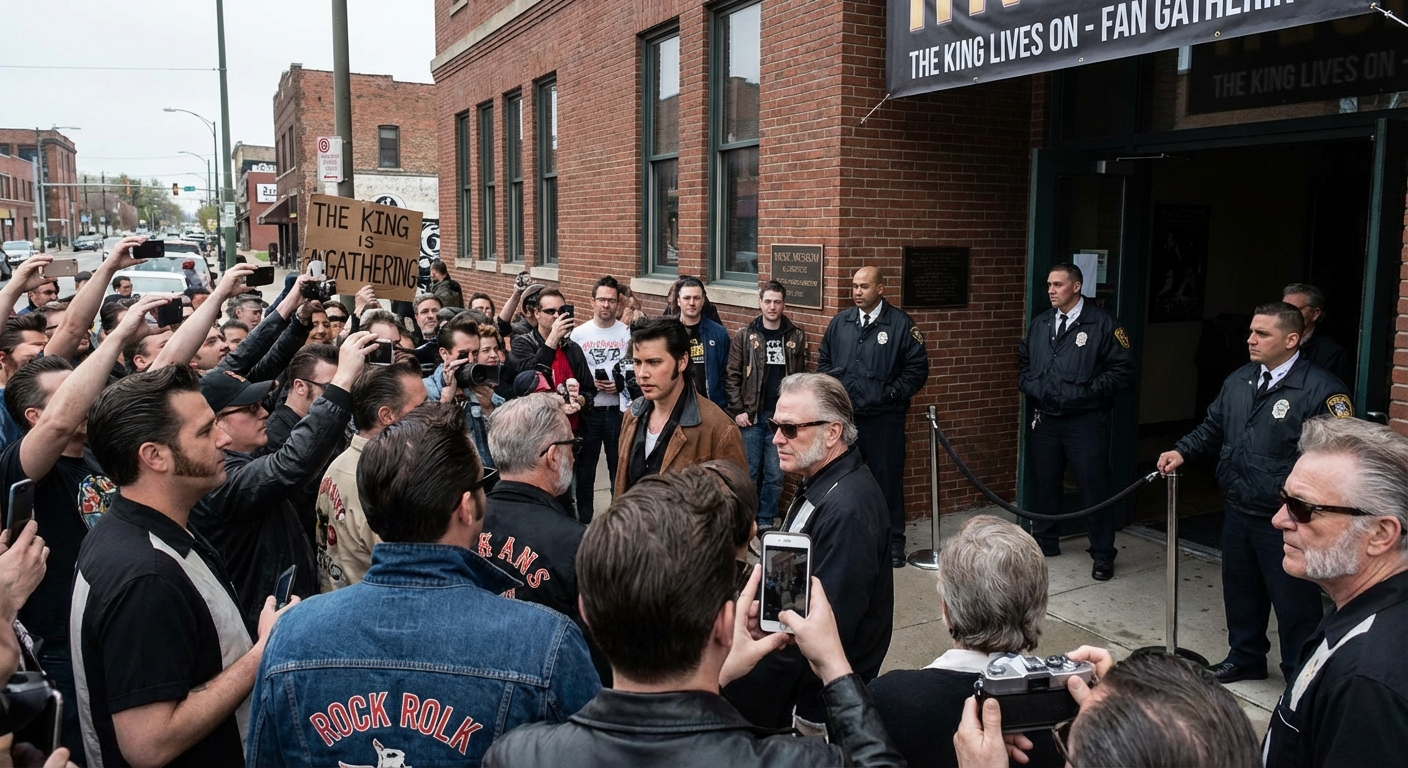
Intro: The items below summarize the arguments people cite to support the claim “Elvis is alive.” These are arguments offered by supporters or investigators, not proof. Each item notes the source type, what a reasonable verification test would be, and what publicly available reporting and official records say when those tests are applied.
The strongest arguments people cite
- Argument: Autopsy results and testing were not fully released, creating an information gap that some interpret as a cover-up.
Source type: Statements from the county medical examiner and reporting in contemporaneous press; family control over records is cited by researchers. Verification test: Obtain the official autopsy report, toxicology results, and chain-of-custody information; compare them to public summaries and contemporaneous medical examiner statements to confirm whether material was withheld and why.Documented origin / evidence: Contemporary reporting quotes Shelby County Chief Medical Examiner Dr. Jerry T. Francisco discussing completed tests and the family’s legal control over some results. Journalists at the time noted that certain materials could remain private if the death was certified as natural.
- Argument: Odd details about public records and memorials — e.g., variations in the spelling of Elvis’s middle name (Aaron vs. Aron) — are presented as deliberate slips or signals that the official story is false.
Source type: Photographs of the tombstone, tabloid claims, and later retellings. Verification test: Review birth records, legal documents, baptismal/official records, and the tombstone inscription; check contemporaneous coverage about the name spelling and any official corrections.Documented origin / evidence: The middle-name spelling has been repeatedly discussed in both tabloids and mainstream media, and appears in conspiracist retellings; mainstream researchers and reporters treat it as a minor, explainable discrepancy rather than evidence of fakery.
- Argument: Multiple alleged sightings and photographs of a man resembling Elvis — at Graceland, in supermarkets, or at public events — are offered as proof he survived and assumed a low profile.
Source type: Eyewitness accounts, casual photography, tabloid journalism, social-media posts. Verification test: Trace original photographs to source files with metadata, interview the eyewitnesses, and cross-reference timing and location against authenticated records of Elvis’s known whereabouts and public schedule before his death.Documented origin / evidence: Numerous purported sightings have been reported and re-reported across decades; major outlets have summarized the sightings and explained how lookalikes, misidentifications, and hoaxes account for most reports.
- Argument: Audio recordings and phone tapes (notably by author Gail Brewer-Giorgio) in which a voice claimed to be Elvis are cited as direct evidence he contacted people after his reported death.
Source type: Recorded phone calls, cassette tapes sold or distributed by proponents. Verification test: Forensic voice comparison with authenticated Elvis recordings and verification of call logs, origins, and chain of custody for the tapes.Documented origin / evidence: The “Elvis phone call” tape and related claims were promoted in the 1980s and 1990s and featured on television specials; investigators and voice experts have said the evidence is not definitive and that the tape’s provenance and authenticity are disputed.
- Argument: Alleged references in declassified or public records (including some FBI files) are interpreted as proof he entered witness protection or staged his death to avoid criminal groups.
Source type: Freedom of Information Act releases, researcher summaries, and books by conspiracy proponents. Verification test: Review the original released documents, examine their context and redactions, and consult subject-matter experts on whether the documents actually connect Elvis to official witness-protection programs.Documented origin / evidence: Some proponents cite partial files or out-of-context excerpts; mainstream researchers who have reviewed the files conclude they do not support claims of witness protection or official conspiracies and that the documents are being misinterpreted.
- Argument: Media spectacles, tabloid special reports, and paid “investigations” (TV specials, books) offered “evidence” such as photographs and eyewitness testimony that many readers remember as persuasive.
Source type: TV specials (e.g., 1991 live shows), tabloid magazines, and books by authors promoting the survival narrative. Verification test: Check producer notes, guest credentials, and follow-up investigative journalism that attempted to verify or debunk specific claims aired in those programs.
Documented origin / evidence: High-profile TV specials and tabloid features in the 1980s–1990s amplified claims; subsequent work by reporters and Elvis researchers has shown many of those pieces relied on misidentified photos, lookalikes, and repeated urban legends.
How these arguments change when checked
When verification tests are applied, the strongest arguments tend to weaken for the following reasons:
- Medical and official records: Contemporary reporting from respected outlets quotes the county medical examiner describing the autopsy process and explaining why certain test results could remain under family control if the death was certified as natural — not because of criminal concealment. That reporting indicates official procedures and family privacy, rather than an institutional cover-up.
- Name and inscription discrepancies: The Aaron/Aron discrepancy and other small public-record oddities are widely documented in both mainstream media and critical summaries; researchers treating primary records conclude these are explainable inconsistencies rather than proof of fakery.
- Sightings and photos: Most sightings trace to lookalikes, poor-quality photos, or misidentifications. Long-term researchers note that thousands of people would have had to be complicit or mistaken over decades for a staged survival to remain secret — an improbable logistical claim compared with the simpler explanation of misidentification and hoaxes.
- Recordings and tapes: The claimed “phone call from Elvis” tapes have contested provenance and limited forensic support; experts and media investigations have found these materials inconclusive. Televised specials amplified uncertain materials for audience effect.
- Documentary evidence like FOIA/FBI files: Researchers who have reviewed the publicly released documents say they do not contain clear confirmation of a staged death or official protection program; proponents’ readings often rely on inference or incomplete context.
Across these checks, independent experts and long-form reporting generally find that the available documentary record and contemporaneous eyewitness testimony support that Elvis Presley died in 1977, while the survival claims are built on ambiguous fragments, misinterpretations, and repeated hoaxes. However, the gaps cited by proponents (controlled family access to some materials, sensational tabloid reporting, and the persistence of ambiguous sightings) are real and are why the claim continues to circulate.
This article is for informational and analytical purposes and does not constitute legal, medical, investment, or purchasing advice.
Evidence score (and what it means)
Evidence score: 18/100
- Most load-bearing primary documentation (autopsy and death certificates) is consistent with a death in August 1977 and has been summarized by officials and contemporaneous reporting.
- Proponents primarily rely on secondary materials: tabloids, disputed recordings, eyewitness reports, and selective readings of public records. These are lower-quality sources for establishing a major factual reversal.
- Where primary records are private or limited, gaps exist — but gaps are not evidence of the claim itself and are often explainable by legal/privacy reasons.
- Independent researchers and journalists who accessed available documents and interviewed participants generally find the survival claim unsupported; this consensus lowers the evidentiary weight of the pro-survival arguments.
Evidence score is not probability:
The score reflects how strong the documentation is, not how likely the claim is to be true.
FAQ
Q: Is there an official death certificate for Elvis Presley?
A: Yes. Elvis Presley’s death in Memphis on August 16, 1977, was widely reported and documented by medical and law-enforcement officials at the time; contemporaneous reporting quotes the county medical examiner and references the investigative file. Requests for full test documentation are constrained by law and family privacy where deaths are certified as natural.
Q: Do FBI files prove Elvis entered witness protection (supporting “Elvis is alive”)?
A: No credible reading of publicly released FBI or other official files has produced concrete proof that Elvis entered witness protection or faked his death. Researchers who examined released documents say the material has been misinterpreted by some proponents. To confirm such a claim would require direct, contemporaneous official documentation explicitly stating that action.
Q: What about the “phone call” tapes that claim Elvis contacted people after 1977?
A: The tapes were promoted in the 1980s and 1990s but have contested provenance and inconclusive forensic support. Investigations and expert commentary treat them as disputed, not definitive evidence. Proper verification would require authenticated call records and robust voice-forensic comparison to established Elvis recordings.
Q: Why do sightings and photos keep appearing if the claim is weak?
A: Celebrity lookalikes, wishful seeing, hoaxes, and poor-quality imagery all explain many sightings. Cultural attachment to Elvis and the commercial incentive for sensational stories also encourage the spread and repetition of unverified sightings. Major outlets and long-term researchers have repeatedly shown how these factors inflate apparent “evidence.”
Q: If the evidence score is low, what would count as strong evidence for the claim “Elvis is alive”?
A: Strong, verifiable evidence would include contemporaneous authenticated documents showing falsification of death records, reliable forensic proof (e.g., an incontrovertible DNA match tying living individuals to Elvis’s verified DNA in a manner inconsistent with the documented death), or unambiguous, well-documented official admissions. None of these exist in the public record.
Closing note
The “Elvis is alive” claim persists because of a mix of incomplete public records, emotional attachment, and a long history of tabloid amplification. When the arguments people cite are traced to primary documents or verified eyewitness testimony, they generally do not stand up to standard verification tests. At the same time, genuine archival gaps and privacy law limits mean questions can remain unresolved in the public mind; that uncertainty fuels circulation but should not be conflated with evidence of survival.

Culture writer: pop-culture conspiracies, internet lore, and how communities form around claims.