
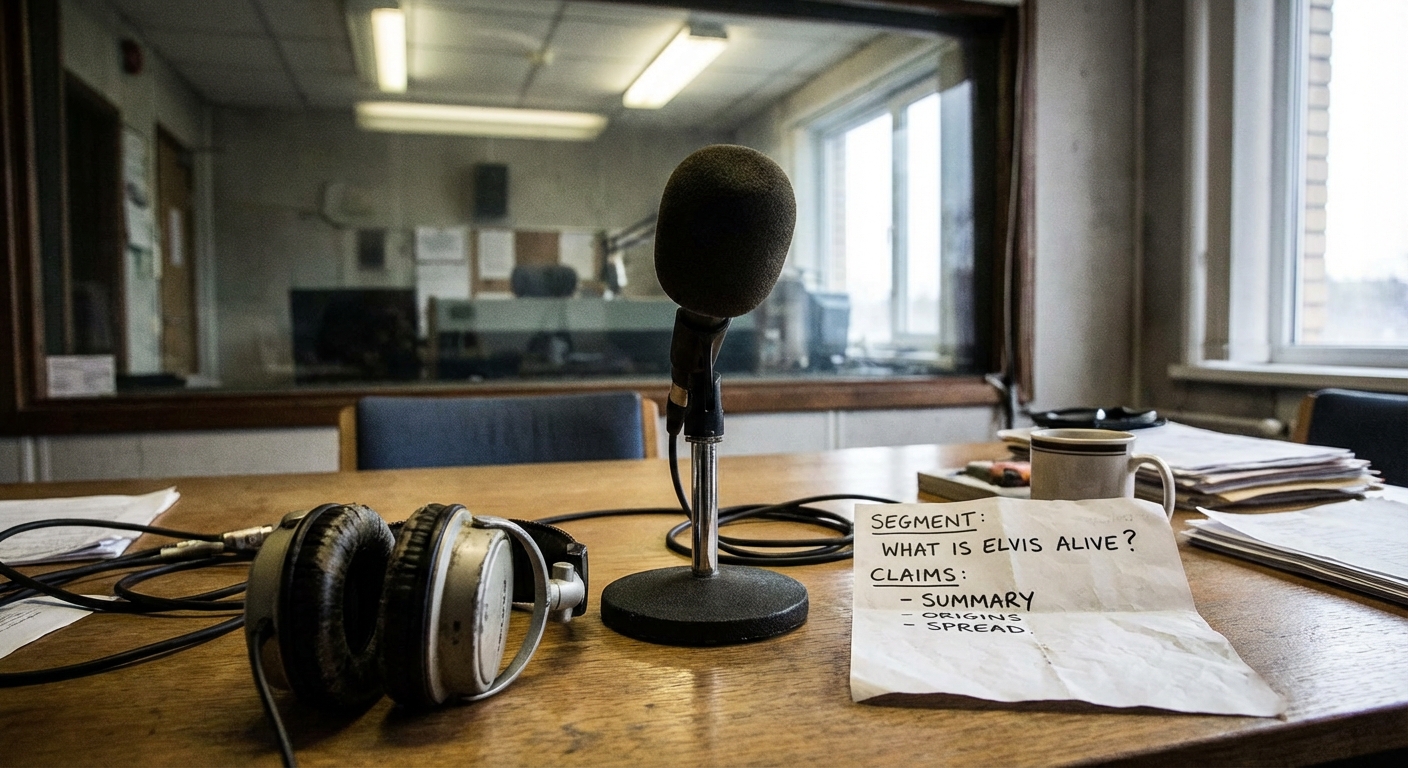
The phrase “Elvis Is Alive” refers to a persistent set of claims that Elvis Presley did not die on August 16, 1977, but instead faked his death or survived and remained hidden. These are conspiracy claims—this article treats them as claims, not established facts—and summarizes who promoted them, what primary documentation exists, where gaps and contradictions appear, and why the story persisted in popular culture. The primary search term this piece uses is “Elvis is alive claims.”
What the claim says
Broadly speaking, the “Elvis Is Alive” claims propose one or more of the following scenarios: that Elvis faked his death and went into hiding (sometimes linked to witness-protection or anti-mafia narratives); that he assumed another identity and resurfaced intermittently; or that public evidence of his death (for example, reporting of his body and burial) was manipulated or staged. Variants emphasize supposed clues such as misspellings on memorials, reported post-1977 sightings, ambiguous photos or audio recordings, and interpretive readings of media coverage or leaked documents. Prominent proponents have framed different versions of the claim with differing supporting details.
Where it came from and why it spread
Several identifiable factors and events contributed to the birth and spread of the “Elvis Is Alive” claims:
- Popular books and media: Gail Brewer-Giorgio’s 1988 book Is Elvis Alive? (and earlier related novels) popularized a version of the story alleging undercover work and witness-protection; other books and TV specials amplified speculation. These works reached wide audiences and were often presented in ways that blurred fiction, interpretation, and claimed documentary evidence.
- Reported sightings and local stories: Early reports of supposed Elvis sightings (the oft-cited Memphis airport “Jon Burrows” anecdote is one example) and later sightings in places like Kalamazoo became viral-feeding stories in print and broadcast outlets. Many of these reports were never substantiated when checked.
- Music and popular triggers: Songs and recordings (for example, the 1988 track “Spelling on the Stone”) and masked performers styled as the persona “Orion” were taken by some listeners as suggestive evidence, which encouraged calls to radio stations and further reports of sightings.
- Media attention and tabloid culture: Network specials, tabloid stories, and later internet forums created an ecosystem where small claims could be repeatedly replayed, amplified, and reframed for new audiences. Sensational coverage made fringe theories culturally persistent even after they were contested.
What is documented vs what is inferred
Documented (primary, verifiable items):
- Elvis Presley was found unresponsive at Graceland and was pronounced dead on August 16, 1977; medical personnel and the Shelby County coroner conducted an examination and issued official findings regarding cause of death. These official records and contemporaneous reporting are part of the public record.
- Public records, media reports, and interviews from the period and afterward document that multiple extortion threats and FBI interest in Presley (as a public figure and potential extortion target) produced an FBI file; those files do not, however, contain corroborated documentation that Presley served as an undercover FBI agent or that the FBI faked his death. Analysts who have reviewed the available FBI documents say they do not support the strongest versions of the witness-protection narrative.
- There are documented commercial and promotional artifacts—books, records, TV specials, and tabloid stories—that intentionally blurred entertainment and documentary claims, and these artifacts contributed materially to the spread of the belief. Examples include Brewer-Giorgio’s book, the Orion/Orion-like masked performer phenomenon, and the “Spelling on the Stone” single.
Inferred or disputed (claims supporters point to these as evidence, but they are not independently verified):
- Assertions that Elvis entered the witness-protection program or that the U.S. government staged his death are inferred from selective readings of documents, anonymous claims, or conjecture rather than direct documentary proof; experts who have examined FBI files and contemporaneous records report no clear evidence supporting those inferences.
- Specific post-1977 sightings, alleged new recordings, or images claimed to show Elvis alive are typically unverified or have been debunked when examined (for example, by checking travel logs, audio forensics, or provenance of photos). Many such sightings trace back to misidentifications, hoaxes, or entertainment promotions.
Common misunderstandings
Several recurring misunderstandings fuel confusion around the claim:
- Confusing commercial fiction and investigative reporting: Some early novels and novelty recordings were perceived as clues rather than entertainment; readers or listeners who were not aware of the artistic context treated those works as documentary evidence.
- Overreading archival documents: The existence of an FBI file on Elvis is factual; the leap from that file to a covert undercover relationship with the Bureau is not supported by the documentary content when independently reviewed.
- Mistaking ambiguous details for proof: Small anomalies—such as variations in how Elvis spelled his middle name in some documents or sensationalized images—have been interpreted by some believers as deliberate “clues,” but documentary reviews show multiple, mundane explanations (e.g., alternate legal spellings, publicity stunts, impersonators).
This article is for informational and analytical purposes and does not constitute legal, medical, investment, or purchasing advice.
Evidence score (and what it means)
- Evidence score: 18 / 100
- Major driver: Strong primary documentation exists for Presley’s death and for routine investigative records (death certificate, hospital records, coroner statements). These documents are publicly recorded and repeatedly cited in reliable reporting.
- Major driver: The strongest counterclaim (that he entered witness protection or that the death was faked) lacks direct archival support; proponents rely on interpretive readings of secondary sources and unverified anecdotes.
- Major driver: A continuous stream of unverified sightings, novelty recordings, and tabloid items amplified belief despite weak provenance; several of these were investigated and found unsubstantiated or explained as hoaxes/marketing.
- Limitation: Some relevant primary files (for example, older FBI documents) are numerous and were redacted or released in voluminous form; interpretation requires careful archival work, so small ambiguities remain.
Evidence score is not probability:
The score reflects how strong the documentation is, not how likely the claim is to be true.
What we still don’t know
Although official death records and contemporaneous medical statements document Elvis’s death, there are areas where gaps or ambiguities—and remaining unanswered questions—persist in the public conversation:
- The full content and interpretation of some archival files (such as extensive FBI records) can be dense and redacted; while reviewers report no evidence of an undercover FBI role, exhaustive, item-by-item public analysis by independent archivists could be deeper than currently available.
- Many alleged sightings lack corroborating documentation (for example, independent travel logs, authenticated recordings, or verifiable provenance of photographs). Where raw material exists, its chain of custody and forensic analysis are often incomplete in the public record.
- How and why particular hoaxes, novelty songs, and promotional stunts (intentional or not) were conceived—especially in the late 1980s—remain partly a matter of anecdote rather than complete archival accounting. Some participants have contradicted each other in later interviews.
FAQ
Are “Elvis is alive” claims credible?
As a body of evidence, the claims lack strong primary documentation to support the most extraordinary versions (for example, that his death was staged or that he entered formal witness protection). Official death records, coroner statements, and contemporaneous hospital reporting are the primary documentary record; those materials are inconsistent with the strongest “still alive” interpretations. However, because the claim space includes many conflicting anecdotes and unverified artifacts, some supporters continue to dispute the documentary record.
Who popularized the idea that Elvis faked his death?
Gail Brewer-Giorgio’s writings (and later expanded editions and media appearances) were instrumental in popularizing the specific narrative that Elvis had been involved with the FBI and entered witness protection; other figures—record producers, novelty-song releases, and tabloid outlets—also played key roles in spreading the story.
Did the FBI confirm Elvis worked as an undercover agent?
No public, verifiable FBI documentation has been shown to corroborate the claim that Elvis was an FBI undercover operative who faked his death. Reviewers of the known FBI files report that while the Bureau maintained a dossier on Elvis (largely related to extortion threats and security concerns), the files do not substantiate that he served as a covert agent.
Why are sightings and hoaxes so common with celebrity deaths?
Celebrity death conspiracies often combine psychological factors (wishful thinking, pattern-seeking), media incentives (sensational stories travel quickly), and commercial/entertainment drivers (novelty recordings, books, and tabloids). These elements create feedback loops: sensational claims attract attention, which generates more content and more believers, even when evidence is weak. The Elvis case is a clear example of this dynamic.
Where can I find the primary documents about Elvis’s death?
Primary reporting on Elvis’s death (hospital statements, coroner comments, contemporaneous newspaper coverage) is widely archived; several reputable news outlets and biographies summarize those records. For researchers, government records (Shelby County coroner reports, hospital records where accessible under law, and public FBI file releases) are the core primary sources cited in scholarly and journalistic reviews. Readers should consult original contemporaneous reporting and archival documents for the most direct evidence.

Culture writer: pop-culture conspiracies, internet lore, and how communities form around claims.