
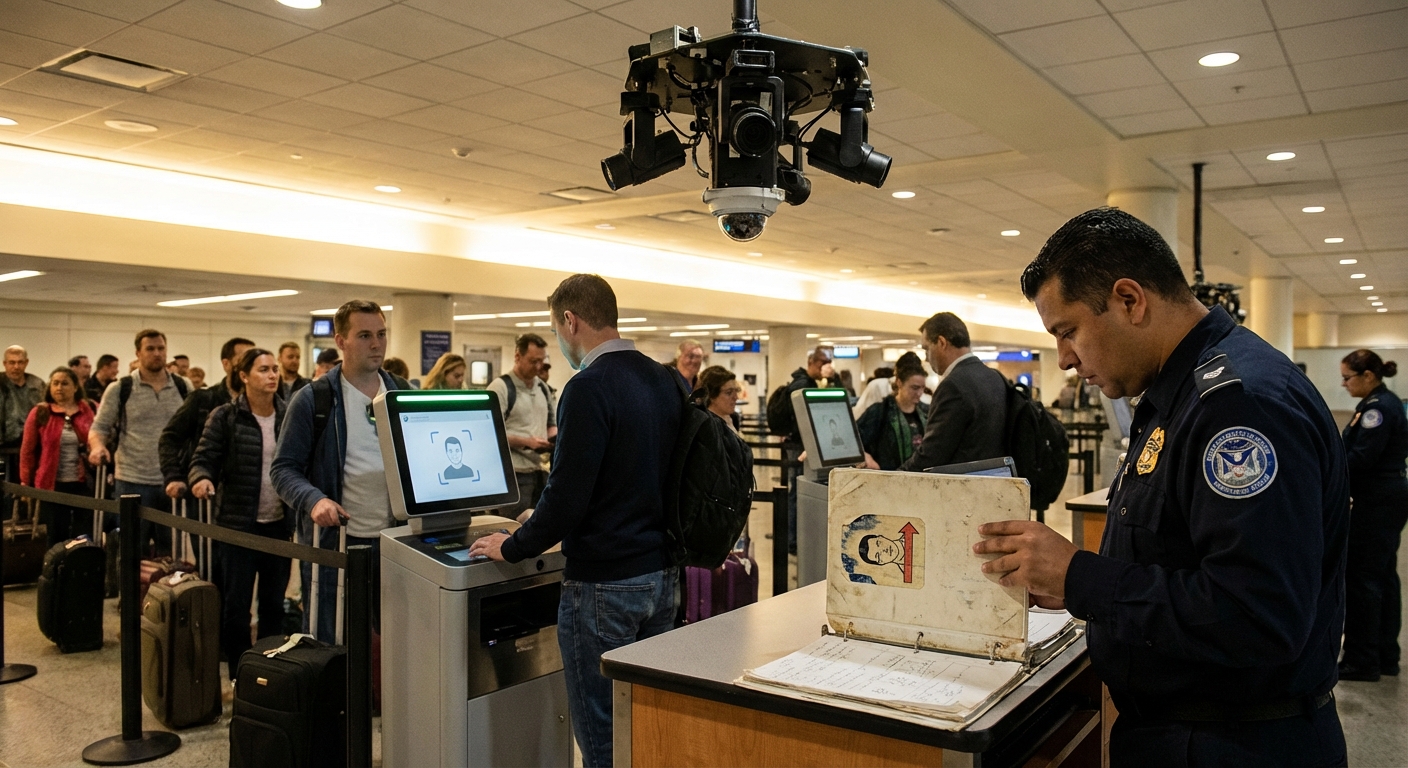
Introduction: the items below are arguments supporters of the “Facial Recognition ‘Everywhere’” claim commonly cite in public debate. They are presented here as claims people make, not as proven facts; each entry lists the source type and a practical verification test readers or investigators can use to check the underlying evidence.
The strongest arguments people cite
- Argument: Government agencies and federal departments widely use facial recognition for travel, border checks, and criminal investigations, implying pervasive public-sector deployment.
Source type: Official agency reports and oversight studies (DHS updates, GAO reviews, U.S. Commission on Civil Rights reports).
Why people cite it: Agencies publish inventories and oversight bodies have documented multiple uses, which supporters interpret as evidence the technology is broadly operational across many federal functions. For example, DHS describes multiple FR/FC (face recognition/face capture) use cases including identity verification at travel checkpoints and investigative support.
Verification test: Request or locate the agency’s publicly released AI/biometric use-case inventory, operational directives, or budget documents; corroborate with GAO or inspector general reports that list active deployments and the scope of those programs. Confirm whether deployments are pilot programs, limited-gallery matches (e.g., against passport photos), or continuous live surveillance.
- Argument: Private-sector scraping and large databases (e.g., companies that index billions of online images) make facial recognition effectively omnipresent because law enforcement and private customers can query those galleries.
Source type: Company statements, press releases, court filings, and litigated settlements (example: public statements by companies such as Clearview AI, and corresponding lawsuits and regulatory actions).
Why people cite it: Vendors have publicly described very large image collections and contracts with law enforcement, which supporters point to as evidence that a searchable, near-universal gallery exists. Clearview AI, for instance, has repeatedly described a very large database and ongoing law-enforcement customers in public statements and in litigation-related materials.
Verification test: Examine court filings, settlement terms, or regulatory orders that specify what data a company retains and who can access it; check whether contracts or procurement records (where publicly available) show active law-enforcement subscriptions; review independent tests or investigative reporting that confirm the database size and access controls.
- Argument: Retailers, venues, and private businesses increasingly deploy face recognition for loss prevention and customer identification, meaning the technology is present in everyday spaces like stores and malls.
Source type: Local investigative reporting, company policy announcements, and state-level legislative activity.
Why people cite it: News investigations and company disclosures have identified specific retailers testing or using biometric systems, prompting local lawmakers to propose bans or stricter rules. Recent local reporting has documented multiple grocery locations using face-based systems and spurred state legislative proposals.
Verification test: Look for direct on-site reporting, company statements or terms of service, public signage requirements (where applicable), and state privacy law filings that reference retailer use. Request copies of vendor contracts through state procurement portals or public records where possible.
- Argument: Consumer devices and commercial APIs (smartphones, social platforms, cloud services) contribute to ubiquity because face-matching technology is embedded in widely used products.
Source type: Manufacturer documentation, SDK/API product pages, major platform privacy policies, and product announcements.
Why people cite it: Many mainstream devices include face-based unlocking, tagging suggestions, or developer APIs that enable facial analysis — supporters point to this breadth of product-level capability as evidence of everyday ubiquity.
Verification test: Check vendor technical documentation and privacy policy pages for explicit face-biometric features; test device behavior on available hardware (e.g., confirm whether face unlocking or tagging is enabled by default), and examine whether third-party apps integrate facial APIs.
- Argument: Accuracy improvements and widely published algorithm tests (e.g., NIST evaluations) demonstrate that recognition works well enough in many settings, so deployments are scaling rapidly.
Source type: Peer-reviewed studies and official algorithm evaluations (NIST Facial Recognition Vendor Tests and follow-up reports).
Why people cite it: NIST and other technical evaluations show substantial improvement in many algorithms and document performance characteristics; supporters infer that better accuracy makes broader deployment feasible.
Verification test: Read the NIST FRVT summary and test reports to see the specific conditions where algorithms improve (controlled photos vs surveillance-quality images), and compare vendor claims to independent benchmarks under equivalent image quality and operational conditions.
- Argument: Lack of uniform regulation, uneven transparency, and limited training/oversight at some agencies mean facial recognition is effectively used without adequate public controls, which supporters read as evidence of opaque, widespread use.
Source type: Oversight reports and audits (U.S. GAO, inspector general findings, civil-rights commission reports).
Why people cite it: Oversight bodies have described inconsistent policies, delayed training, and gaps in civil-rights protections across agencies — supporters interpret those gaps as enabling broader, less-visible deployment.
Verification test: Review GAO and inspector general reports for documented policy gaps; check agency public records for training requirements, procurement timelines, and privacy impact assessments tied to specific deployments.
How these arguments change when checked
When each argument above is examined against primary documents, the overall picture becomes more nuanced than the simple statement “facial recognition is everywhere.” Several high-quality sources confirm that facial recognition is actively used in multiple federal and commercial contexts, but they also show limits, exceptions, and important distinctions about scale and scope.
Documented: Multiple federal agencies acknowledge active uses (travel/identity verification, limited-gallery matching, investigative leads) and have published inventories, directives, and oversight reviews describing those programs. For example, DHS publishes a use-case inventory and has described travel-related identity verification as a common operational use; GAO has identified at least seven federal law enforcement agencies reporting use to support investigations. These are primary, authoritative sources documenting concrete deployments.
Plausible but often overstated: Vendor claims about the absolute size of searchable image databases and the practical reach of those databases can be partially documented (through company statements and some legal filings), but the real-world access, refresh cadence, and operational controls are variable and sometimes redacted or disputed in litigation. Clearview AI has publicly asserted a very large image index and law-enforcement customers, but independent verification of every claim about scope and usage is limited and contested in courts and regulatory actions.
Contradicted or limited: Improvements in algorithm accuracy reported by NIST largely reflect controlled test conditions; they do not uniformly translate to high accuracy in low-resolution, blurred, or real-world surveillance footage. Research shows demographic differentials and greater error rates in some operational scenarios (e.g., 1-to-many identification from low-resolution surveillance images), which undercuts any claim that the technology is uniformly reliable wherever it is used.
On retail and private deployments, investigative reporting documents real examples of store-level use and has prompted state legislative responses; however, those examples are geographically patchy, not universal, and in many places the practice remains subject to disclosure rules or pending regulation. Recent local reporting has led to proposed state bans and prompted company responses.
Evidence score (and what it means)
-
- Evidence score: 62/100
- Drivers:
- Direct agency documentation (DHS inventories, GAO reviews) confirms multiple, concrete federal uses.
- Vendor public statements and litigation filings document some large private databases, but independent access and verification are limited.
- Peer-reviewed and government testing (NIST, academic studies) show algorithm improvements but also important performance limits in surveillance-like conditions.
- Local investigative reporting confirms real-world private deployments but shows the phenomenon is uneven across locations and business types.
- Oversight reports highlight policy, training, and transparency gaps that increase uncertainty about the true scale and controls around use.
Evidence score is not probability:
The score reflects how strong the documentation is, not how likely the claim is to be true.
This article is for informational and analytical purposes and does not constitute legal, medical, investment, or purchasing advice.
FAQ
Q: What does the phrase “facial recognition everywhere” mean in these arguments?
A: Supporters typically use the phrase to mean facial recognition systems are deployed across many everyday settings (public agencies, retail, travel, consumer devices). The available documentation shows multi-sector use but also important limits: federal travel and investigative uses are well-documented, private deployments are spotty and often localized, and device-level capabilities do not always translate into continuous public surveillance.
Q: How reliable is the evidence that vendors maintain very large searchable image databases?
A: Vendor statements and some legal documents assert large indexes; these are primary sources for that claim. However, independent verification of size, access patterns, and law-enforcement use is often limited by nonpublic contracts and litigation confidentiality. Where regulators or courts have compelled disclosures, those provide stronger evidence. For example, company filings and press statements have been central to the public record about Clearview’s database claims.
Q: Does better accuracy in NIST reports mean facial recognition works well ‘everywhere’?
A: No. NIST shows substantial algorithmic improvement under many test conditions but also documents demographic differences and performance degradation in low-quality images. Controlled test results do not automatically translate to uniformly high performance in real-world, low-resolution surveillance environments. That limitation is critical when assessing claims of ubiquity and reliability.
Q: Is there consensus among oversight bodies about the risks and scale of facial recognition use?
A: Oversight bodies (GAO, U.S. Commission on Civil Rights, inspector generals) agree there are civil-rights, privacy, and governance risks and that policy and training gaps exist. They document concrete uses by federal agencies but do not uniformly claim that the technology is literally omnipresent in all public spaces. Where oversight and transparency are weakest, uncertainty about scale increases.
Q: How can a reader test a local claim that facial recognition is being used “everywhere” in their city?
A: Practical steps include: searching local news investigations; requesting public records (procurement contracts, grant awards, purchase orders) under state freedom-of-information laws; checking municipal privacy policies and police procurement pages; and looking for required signage or disclosures at private businesses. If you suspect federal use (e.g., at an airport), consult DHS or CBP public materials and their use-case inventories.
How we checked sources and what we could not verify
We prioritized primary documents (agency reports, GAO, regulatory and oversight releases) and high-quality investigative reporting. Where claims relied primarily on vendor PR or litigation statements, we flagged those as requiring additional independent verification. Some vendor database size and access details remain subject to confidentiality or contested in court, so independent confirmation is limited. When authoritative sources disagree or emphasize different limits, we note that conflict rather than speculate.
How to interpret future claims
- Ask for primary documentation: procurement records, agency inventories, or court filings.
- Differentiate use-cases: one-to-one verification (e.g., passport checks) behaves differently from continuous one-to-many surveillance.
- Check image quality: expected performance depends critically on camera resolution and conditions; lab claims often do not translate to poor-quality footage.
- Watch for oversight updates: GAO, inspector generals, and civil-rights commissions frequently publish follow-ups that clarify scale and governance.
End of article.

Tech & privacy writer: surveillance facts, data brokers, and what’s documented vs assumed.