
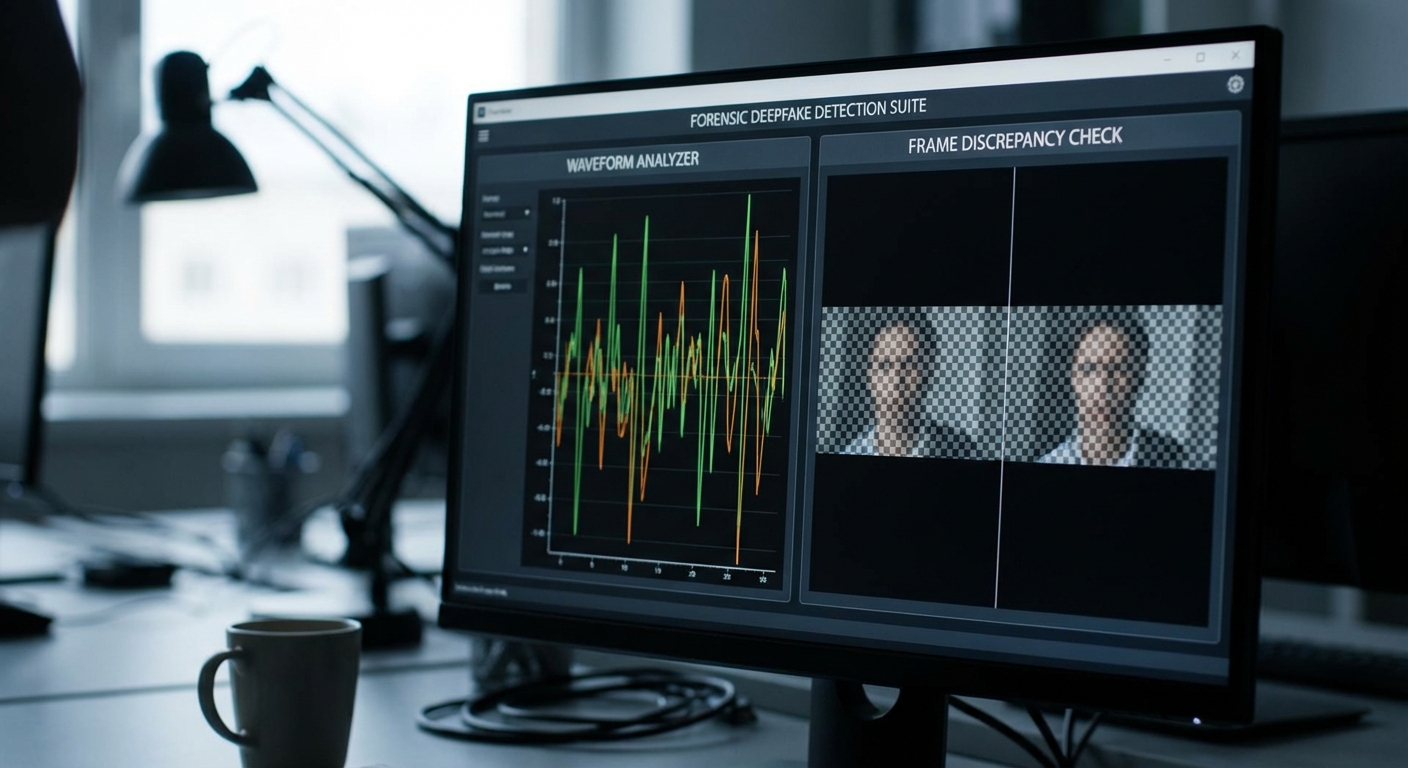
Intro: The items below summarize the strongest arguments people cite to support the claim commonly framed as the “Deepfakes and ‘Nothing Is Real’ panic.” These are arguments made by observers, advocates, and media sources — they are not treated here as proven facts. For each argument we identify where it typically comes from and a straightforward verification test readers or reporters can use.
The strongest arguments people cite
-
Claim: Deepfakes can convincingly impersonate public figures and ordinary people, making recorded evidence unreliable.
Source type: High-profile viral examples and news reporting (e.g., a synthetic clip of a world leader or short viral audio). Verification test: Track the earliest posting, check for attribution or takedown notices from platforms, compare to verified official statements, and examine forensic detector outputs and provenance metadata when available.
Notes & evidence: Well-circulated examples include a manipulated clip of Ukraine’s president that circulated in March 2022 and was widely reported and removed after debunking. Those incidents demonstrate that convincing fakes have been created and shared, but each incident requires case-by-case verification.
-
Claim: Deepfakes have been used to influence elections and political narratives — sometimes just before votes — and therefore can change outcomes.
Source type: Reports from election observers, think tanks, and investigative journalism describing pre-election synthetic audio/video. Verification test: Identify timing relative to polls/election, measure reach, and look for follow-up forensic analyses or official investigations that link behavior change to the content.
Notes & evidence: Analysts have documented synthetic audio used in the run-up to elections in Europe (e.g., Slovakia in 2023) and policy briefings warn of such risks; however, attribution and measurable impact on votes are often disputed or unproven.
-
Claim: Deepfakes facilitate non-consensual sexual images and targeted harassment at scale.
Source type: Investigative reporting and platform takedown notices. Verification test: Confirm whether images were machine-generated (examining artifacts, reverse-image search, and origin timestamps) and whether platform moderation logs or press statements confirm policy response.
Notes & evidence: Multiple high-profile reporting cycles (including celebrity-targeted synthetic explicit images) show rapid spread on social platforms and regulatory attention; platforms’ policies and enforcement actions vary and sometimes lag events.
-
Claim: Automated detection tools are unreliable in the wild, so neither platforms nor law enforcement can be counted on to stop harmful deepfakes.
Source type: Technical benchmarks, academic papers, and government advisories. Verification test: Compare detector performance on benchmark datasets versus cross-dataset or compressed real-world examples; check vendor claims against independent evaluations.
Notes & evidence: Detection algorithms can score highly on curated datasets but generalize less reliably to different codecs, compressions, lighting, and new synthesis methods; government advisories recommend layered defenses beyond detection alone.
-
Claim: Legal and policy responses are inconsistent and contested, which amplifies public anxiety about whether anything can be trusted.
Source type: Legislative texts, lawsuits, and news coverage of platform-policy disputes. Verification test: Read the law or policy language, track legal challenges, and note differences across jurisdictions.
Notes & evidence: U.S. states and governments have pursued varying approaches (some state bans on political deepfakes, met with First Amendment challenges), and platform-policy disputes have been covered in national reporting. The interaction of law, litigation, and platform policy fuels uncertainty.
How these arguments change when checked
When researchers, journalists, and platform teams inspect the strongest arguments above, common patterns appear:
-
Confirmed or documented elements: Creation and circulation of deepfakes is demonstrable in many cases; clear examples (public-figure fakes, celebrity image abuse) have been identified, removed, and reported by multiple outlets. These show the underlying capability exists.
-
What collapses under scrutiny: Broad claims that “nothing is real anymore” or that every viral video is fake do not hold up. Most content is still authentic; aggregate analyses and platform data typically show a minority of viral content is convincingly synthetic at any given time. When precise attribution and impact are demanded, many high-profile assertions lack the chain of evidence (origination, alteration timeline, demonstrable downstream effects).
-
Limits of detection and generalization: Technical studies show detectors can perform well on curated datasets but struggle with compressed, low-quality, or novel-forgery examples. That means a clean detector score is a useful signal but not definitive proof; provenance and human review remain important.
-
Policy and legal complexity: Laws aimed at political deepfakes have faced constitutional and implementation challenges, so legal remedies are partial and geographically uneven; this contributes to public anxiety but does not imply systems are entirely broken.
This article is for informational and analytical purposes and does not constitute legal, medical, investment, or purchasing advice.
Evidence score (and what it means)
- Evidence score: 62 / 100
- Drivers of the score:
- Directly documented incidents of convincing deepfakes exist and are well-reported (raises the score).
- Authoritative advisories (e.g., interagency cybersecurity guidance) recognize the threat but emphasize layered responses rather than single-signal reliance. This supports caution but not alarm.
- Technical literature shows strong benchmark performance but persistent generalization gaps in real-world conditions, so detection cannot be the sole proof.
- Claims about broad societal collapse of trust are often extrapolated from limited incidents and lack measurable, causal evidence linking deepfakes to major social outcomes. This reduces the score for sweeping assertions.
- Legal/policy responses are emerging but inconsistent across jurisdictions, meaning governance is partial rather than comprehensive.
Evidence score is not probability:
The score reflects how strong the documentation is, not how likely the claim is to be true.
FAQ
Q: What does the phrase “Deepfakes and ‘Nothing Is Real’ panic” mean in practice?
A: It is a shorthand critics and observers use to describe widespread anxiety that synthetic media will undermine trust in any recorded evidence. The panic-framing bundles technical capability, notable incidents, and speculative worst-case impacts; our review treats those as claims to be tested rather than settled facts.
Q: How reliable are deepfake detection tools today?
A: Detection tools show strong results on benchmark datasets and controlled experiments, but cross-dataset and in-the-wild performance drops are documented. In short, detectors are improving but are not foolproof; combining detection with provenance checks and human review is recommended.
Q: Could deepfakes realistically flip an election?
A: Theoretical risk exists and targeted incidents have occurred near elections, but proving a causal effect on election outcomes requires rigorous evidence (timing, reach, targeted demographics, and measurable behavior change). Available reporting documents attempts and near-misses but not clear, reproducible cases where a deepfake alone flipped a vote.
Q: How should I evaluate a suspicious video or audio I see online?
A: Check the source and timestamp, look for corroborating reports from reputable outlets, search for official statements from the person or institution depicted, run basic forensic checks (reverse image search, metadata when available), and treat a single unverified clip as inconclusive until multiple verification steps are completed.
Q: Is the “Deepfakes ‘Nothing Is Real’ panic” justified?
A: Anxiety is understandable because synthetic media capabilities have advanced; however, the panic framing overgeneralizes. Evidence supports concern and targeted risk mitigation, but not an all-encompassing collapse of trust. Where evidence conflicts (e.g., detector claims vs. real-world failures), researchers and reporters flag those conflicts rather than speculate.

Beginner-guide writer who builds the site’s toolkit: how to fact-check, spot scams, and read sources.