
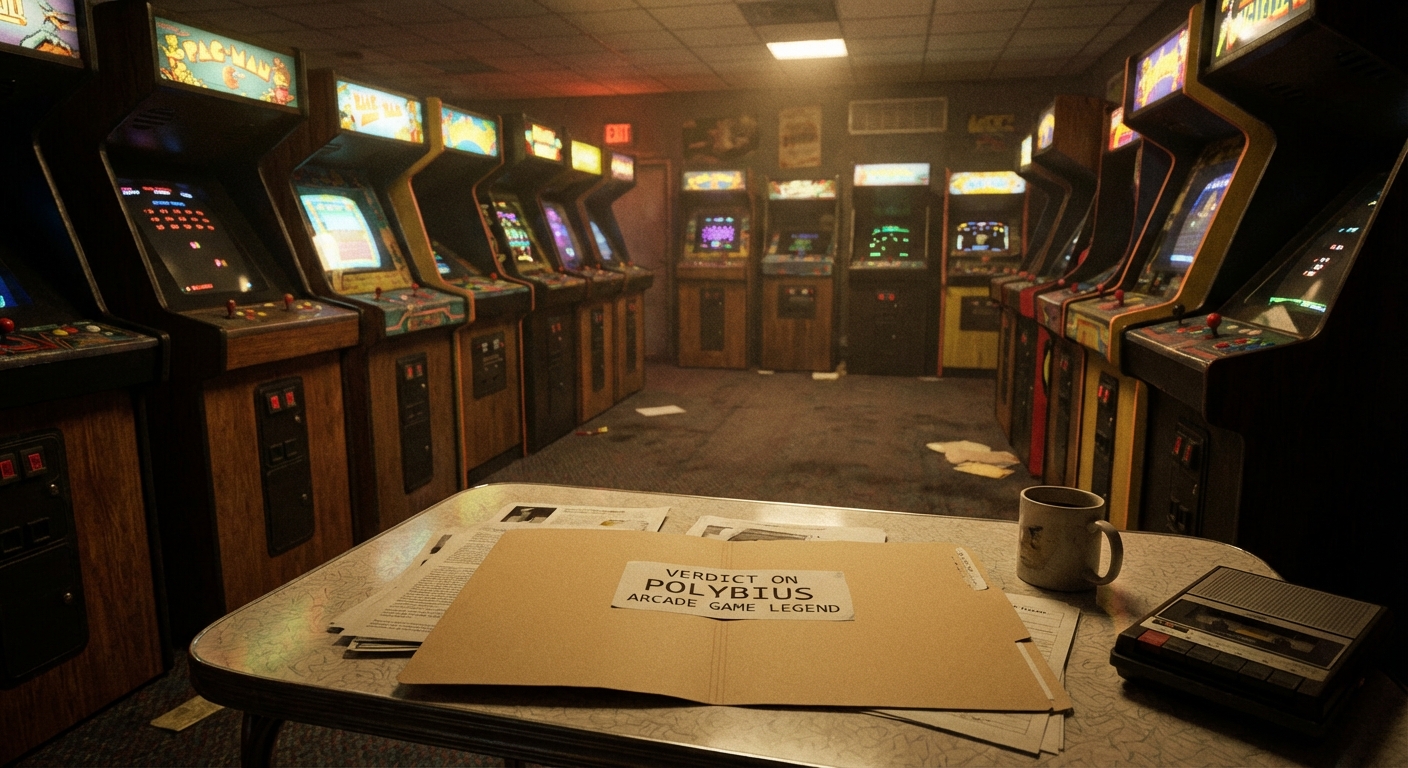
This article examines the claim known as the Polybius arcade game legend — the story that a mysterious, psychoactive arcade cabinet called “Polybius” briefly appeared in Portland-area arcades in 1981 and was removed after causing neurological and psychological harm. We treat the story as a CLAIM and review the available documentary record, contemporary reporting, and later testimony to say clearly what is documented, what remains plausible but unproven, and what lacks support.
Verdict: what we know, what we can’t prove
What is strongly documented
• The earliest widely available online record for the Polybius story is an entry on the arcade-collector website CoinOp.org (originally posted in the late 1990s). That entry contains the basic legend elements (a 1981 date, a publisher name shown in the screenshot, and anecdotal claims about health effects).
• The story entered mainstream gaming coverage in or around September 2003 when GamePro ran a feature on video-game urban legends that mentioned Polybius and described the available evidence as inconclusive. Multiple later summaries and encyclopedia entries (including specialist outlets and general references) cite that print mention as a turning point in the legend’s spread.
• Independent critical reviews and skeptical investigations (for example, Skeptoid and encyclopedia-style sources) report that there are no contemporaneous newspaper, magazine, or trade-journal records confirming the existence of Polybius, and that no authenticated ROM image or original cabinet has been produced for public verification. Those works argue the available evidence is weak or absent.
What is plausible but unproven
• Some elements of the legend echo real and documented 1980s events: documented incidents of people falling ill while playing arcade games (for example, migraine or collapse reports tied to high-intensity games), and FBI activity in Portland in 1981 that involved arcade operators and illegal gambling conversions. These documented, unrelated events plausibly seeded or amplified memory distortions and rumor formation that later coalesced into the Polybius narrative. However, the inference that those events directly produced a specific Polybius cabinet is not proven by the records.
• In later years a handful of individuals and communities produced recreated Polybius-style games, photos of modern mock-up cabinets, or claims of personal memory. Those recreations and retrospective testimonials plausibly explain how the legend persisted and grew, but they are not primary evidence that an original 1981 cabinet with the alleged properties existed.
What is contradicted or unsupported
• There is no verified archival or contemporaneous documentation (1981 trade press, local newspapers, police/FBI public records showing a Polybius cabinet and its effects) that confirms a Polybius machine matching the legend was deployed. The absence of such primary sources is a major strike against the claim as a documented historical event.
• Repeated elements of the story that tie Polybius to government mind-control programs (for example, MK-Ultra-style experimentation or secret agencies deliberately inducing seizures and amnesia for research) lack corroborating documents or credible official confirmation. Those parts of the narrative remain speculative and unsupported in the public record.
Evidence score (and what it means)
- Evidence score: 12/100
- Earliest traceable source is a late-1990s coin-op community entry rather than 1980s primary reporting; that weakens documentation.
- No authenticated ROMs, cabinets, or contemporaneous print records from 1981 have surfaced despite decades of interest; this absence lowers the score.
- Some later first-person claims and a 2006 forum post (an unverified “Steven Roach” narrative) supply colorful details but lack corroborating evidence or verifiable provenance.
- Cultural and documented events from the early 1980s (arcade-related illnesses, FBI raids on illegal gambling) plausibly explain parts of the legend but do not prove the core claim.
- Modern recreations and media attention have amplified the story and produced artifacts (games and cabinets) that are clearly derivative and not evidence of an original 1981 cabinet.
Evidence score is not probability:
The score reflects how strong the documentation is, not how likely the claim is to be true.
Practical takeaway: how to read future claims
When you encounter assertions about Polybius (or similar retro-arcade conspiracies), apply basic source tests: ask whether a claim rests on contemporaneous primary reporting (local newspapers, police reports, trade press), physical evidence (an original cabinet or verified ROM), or only later reminiscences and recreated artifacts. Recognize that later testimonials and creative recreations are important for cultural history but do not replace primary historical documentation.
This article is for informational and analytical purposes and does not constitute legal, medical, investment, or purchasing advice.
FAQ
Q: Is the Polybius arcade game legend true?
A: The claim that a specific arcade cabinet called Polybius appeared in 1981 with the psychoactive effects described is not supported by contemporaneous documentation or physical evidence. Major reviews and skeptical analyses report no verified 1980s newspapers, trade magazines, ROMs, or cabinets that substantiate the core claim.
Q: Where did the Polybius story first appear?
A: The earliest widely-cited online entry is the CoinOp.org page created in the late 1990s; the story reached a wider audience after a GamePro feature in 2003 that characterized the evidence as inconclusive. Those two items are the key early nodes of the legend’s digital spread.
Q: Have any people claimed to have worked on the original Polybius?
A: Yes—over time a small number of forum posts and interviews have asserted involvement (for example, a 2006 post by someone using the name “Steven Roach”). Those claims have not been independently verified and are treated by researchers as anecdotal. They increase the story’s detail but do not constitute proof.
Q: Could Polybius be a conflation of real 1980s events?
A: Yes. Scholars and skeptics point to documented incidents—players collapsing or suffering migraines while playing intense games, and law-enforcement activity around arcades in Portland circa 1981—as plausible seeds for the Polybius legends. These documented events may help explain why the narrative felt believable, even if they do not confirm a specific Polybius machine.

Myths-vs-facts writer who focuses on psychology, cognitive biases, and why stories spread.