
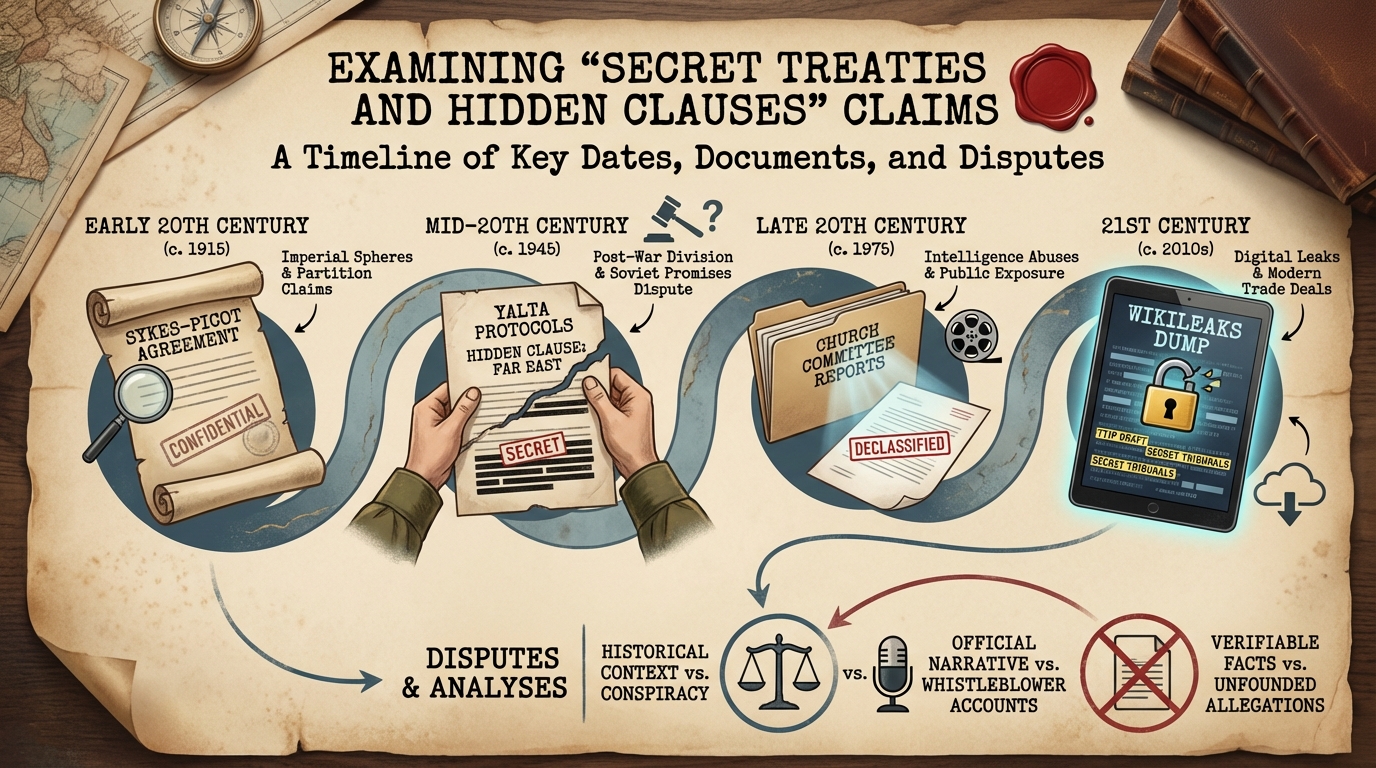
Intro: scope and purpose. This timeline treats the phrase “secret treaties and hidden clauses” as a CLAIM under review. It documents key moments when allegedly secret agreements or concealed treaty clauses were signed, published, or debated, and it separates documented records from disputed or unproven assertions. The goal is to list dates, the kinds of documents cited, and turning points where transparency changed — then note where evidence is strong, ambiguous, or contradicted.
This article uses the search phrase “secret treaties and hidden clauses” throughout to keep the focus on the claim and on documentary evidence. It does not assume these claims are true; it instead catalogs primary documents, official publications, and reputable secondary analyses that supporters and skeptics refer to.
This article is for informational and analytical purposes and does not constitute legal, medical, investment, or purchasing advice.
Timeline: key dates and turning points
- April 26, 1915 — Treaty of London (secret agreement bringing Italy into WWI). Event: The Treaty of London promised Italy territorial gains in return for joining the Allies; it was negotiated in secret and intended to remain confidential. Source type: treaty text and diplomatic records later published and studied by historians.
- 1916 / November 1917 — Sykes–Picot Agreement. Event: A secret memorandum between Britain and France that outlined spheres of influence in the Ottoman Middle East; a copy was released publicly by the Bolshevik government in November 1917. Source type: diplomatic memorandum and subsequent Bolshevik publication of documents.
- October 1917–1918 — Bolshevik publication of formerly secret treaties. Event: After seizing official papers, the Soviet government published assorted secret treaties and agreements from the Tsarist and Provisional governments to make the secret diplomacy of the old regimes a public issue. Source type: press publications and official proclamations from the new Soviet government.
- August 23–24, 1939 — Molotov–Ribbentrop Pact and its secret protocol. Event: The public non-aggression pact between Nazi Germany and the Soviet Union had an additional, secret protocol that allocated spheres of influence in Eastern Europe; its existence was later established by recovered texts and scholarly work. Source type: treaty text and published secret protocol(s), archival documents.
- October 1944 — Churchill–Stalin “Percentages” agreement. Event: Winston Churchill recorded an informal division of influence in the Balkans (the so‑called “Percentages agreement”) in his memoirs; historians debate its importance and whether it amounted to a formal secret treaty. Source type: private memo/memoir account and later historical analysis; its characterization as a binding secret agreement is disputed.
- Post‑1945 — Cold War-era secret protocols and understandings. Event: Various wartime and postwar understandings, protocols, and side agreements (formal and informal) shaped spheres of influence; some were later declassified or discussed in memoirs, others remain the subject of archival research. Source type: conference minutes, diplomatic correspondence, and later declassification efforts.
- 1980s–1990s onward — Allegations of modern secret treaties and “hidden clauses” (trade, intelligence, UAP/UFO claims). Event: Two broad modern strands appear in public discussion: (A) secrecy complaints about trade and investment agreements (confidential side letters, investor‑state dispute settlement procedures, restricted negotiation rooms), and (B) popular claims of covert government arrangements with non‑state actors (for example, alleged government–extraterrestrial treaties such as MJ‑12 narratives). Source type: leaked negotiation drafts, investigative journalism, FOIA/CIA documents, and cultural/literature circulation of alleged documents.
- 2010s–present — Transparency reforms and public releases. Event: In response to leaks and public criticism, institutions like UNCITRAL introduced transparency rules for investor–state arbitration; national archives and FOIA processes have also produced previously classified treaty materials. Source type: international rules and FOIA releases.
Where the timeline of secret treaties and hidden clauses gets disputed
Even where secret agreements existed historically, disputes arise over three main questions: (1) whether an agreement was in fact secret or merely confidential for diplomatic reasons; (2) whether an informal understanding (a memo, a scrap of paper, a private note or conversation) counts as a “treaty” or as a non‑binding diplomatic exchange; and (3) whether later publications or leaks reflect full, original texts or forgeries/alterations.
Examples of contested points:
- Formal secret treaties that were later published: The Treaty of London and the Sykes–Picot memorandum are strong examples where text or authoritative summaries exist and were later published; such entries are well documented in diplomatic archives and secondary historical literature.
- Secret protocols with significant consequences: The Molotov–Ribbentrop secret protocol is supported by surviving texts and later scholarly and archival confirmation; because the protocol was explicitly designated “secret” in the documents, it is widely treated as a documented example of secret treaty practice.
- Informal/dubious documents: The “Percentages agreement” is a case where the primary source is Churchill’s memoirs and related memos; historians note it was informal and some contemporary actors denied or downplayed it, so its weight as a binding secret treaty is disputed. Scholars cite Churchill’s account but also stress the limits of corroboration.
- Alleged modern clandestine treaties with non‑state actors or extraordinary claims: Narratives about secret government treaties with extraterrestrials (e.g., MJ‑12) stem from documents and testimonies widely judged by intelligence historians and archival researchers to be forged or uncorroborated; official FOIA/agency records and academic investigators have flagged such materials as dubious or fabricated. These claims remain unproven and are treated by mainstream historians and the intelligence community as lacking verified documentary support.
- Hidden clauses inside modern trade or investment pacts: Criticism that modern trade deals contain “hidden clauses” often refers to confidential side letters, restricted access to draft texts, or ISDS provisions that were negotiated in secrecy; these are not conspiratorial single‑page secret treaties but are policy choices about transparency that have been challenged and in some cases reformed. UNCITRAL and other bodies have introduced transparency rules in response to these criticisms.
Evidence score (and what it means)
Evidence score is not probability:
The score reflects how strong the documentation is, not how likely the claim is to be true.
- Evidence score: 62 / 100.
- Drivers: multiple well‑documented historical secret agreements exist (e.g., Treaty of London 1915, Sykes–Picot 1916, Molotov–Ribbentrop secret protocol), which raises the general plausibility that governments have used secret clauses historically.
- Drivers: substantial archival publication (Bolshevik releases, declassified treaty texts, FOIA/CIA releases) provides primary evidence for several key cases.
- Limits: many contemporary or sensational claims (e.g., alleged extraterrestrial treaties, sensational single‑document exposures) are not supported by corroborated primary documents and are flagged by FOIA/CIA records or archival research as forged or unverified.
- Limits: the boundary between “informal diplomatic understanding” and “binding secret treaty” is often contested; some so‑called “secret” items are informal notes or memoir recounting rather than signed, witnessed treaties (example: the Percentages note).
- Limits: modern contexts (trade ISDS, side letters) can produce genuine hidden clauses, but these are operationally different from once‑secret territorial carve‑ups; documentation quality varies by jurisdiction and institution.
FAQ
Q: What counts as evidence for claims about secret treaties and hidden clauses?
A: The strongest evidence is contemporaneous, authenticated treaty texts or protocols (signed originals or certified copies, archived official records, or authoritative publications of those documents). Secondary confirmation can include multiple independent archival holdings, corroborating diplomatic correspondence, and later declassification that matches earlier leaks. Where memoirs, press reports, or single anonymous documents are the only source, the evidentiary value is lower and requires independent corroboration. Examples: Sykes–Picot and parts of the Treaty of London are corroborated by archival texts; MJ‑12 style documents are treated as uncorroborated by FOIA/archival reviewers.
Q: How common were secret treaties historically?
A: Secret treaties and confidential protocols were common in 19th and early 20th century diplomacy; historians have cataloged many examples across centuries. Their frequency fell after public‑diplomacy reforms in the 20th century, though secret or confidential understandings continued to appear in wartime and high‑stakes bargaining.
Q: Do contemporary trade deals still have “hidden clauses”?
A: Modern trade and investment negotiations sometimes use confidential side letters or restricted access to draft texts. Critics have called investor–state arbitration “secret trade courts”; in response, transparency initiatives (for example, UNCITRAL Rules on Transparency, and public disclosure practices in some treaties) have been adopted to reduce secrecy. The documents exist and the debate is about governance and access rather than about proof of conspiratorial single‑page treaties.
Q: Can a single leaked document prove an extraordinary secret‑treaty claim?
A: No—extraordinary claims require corroborating evidence: authenticated originals, archival provenance, multiple independent holdings, or official admission. Single leaked or unsourced documents should be treated cautiously and investigated for provenance and forgery risks. Historical practice shows that some disclosures are genuine (published treaties), while others are fabricated or uncorroborated.
Q: How should researchers proceed if they find an alleged “secret clause”?
A: Verify provenance (who held the document, how it was released), cross‑check with archives and contemporaneous correspondence, consult FOIA/archival catalogs, check secondary scholarship, and remain cautious about treating informal memos or memoir recollections as binding treaties. If sources conflict, report the conflict and avoid asserting the claim as fact.

Beginner-guide writer who builds the site’s toolkit: how to fact-check, spot scams, and read sources.