
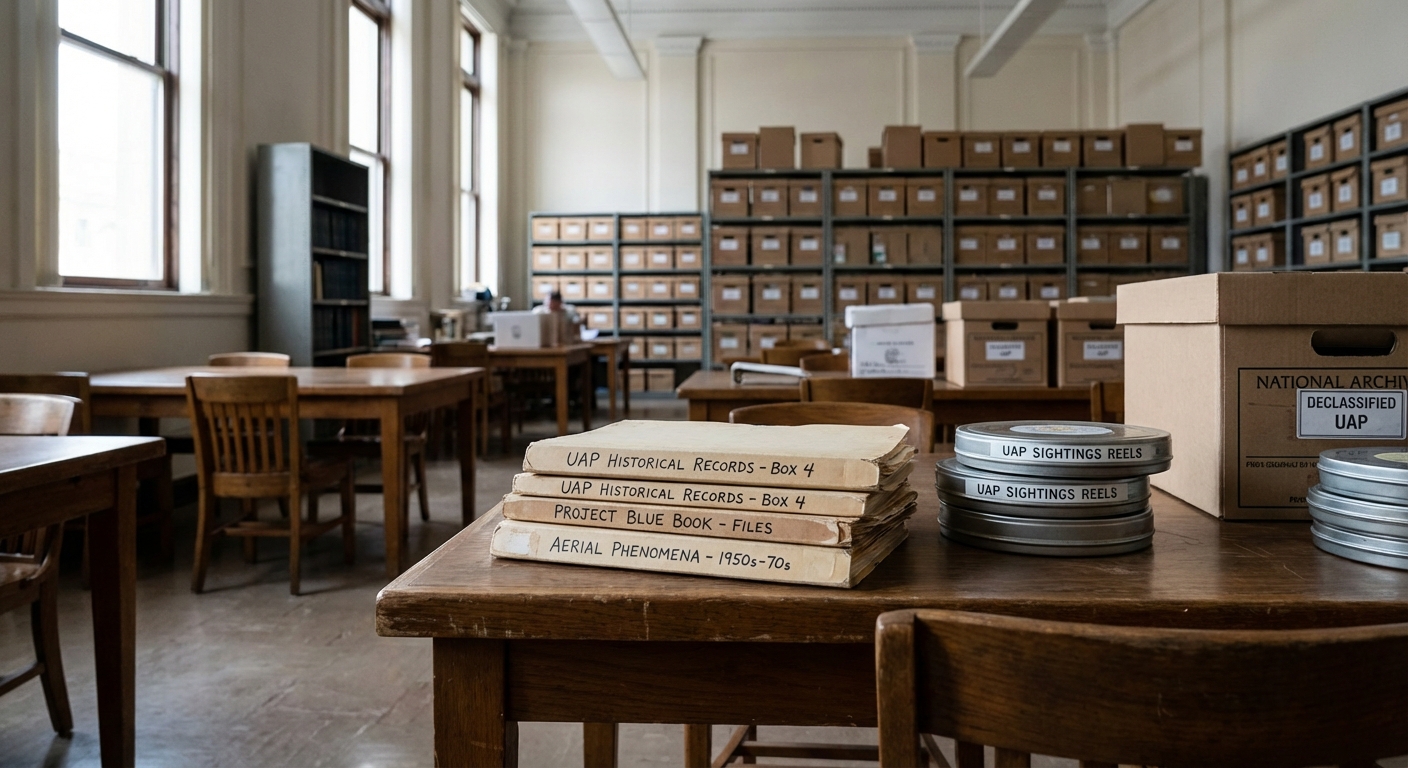
This timeline surveys the documented record behind contemporary UFO/UAP “disclosure” claims, listing key dates, official documents, and turning points. The scope is the claim set commonly labeled “UFO/UAP ‘Disclosure’ Claims” — i.e., assertions that governments possess and have concealed extraordinary physical artifacts, programs, or conclusions. The article treats those assertions as claims and separates what is documented from what is disputed or unproven, citing primary and high-trust sources for each entry.
This article is for informational and analytical purposes and does not constitute legal, medical, investment, or purchasing advice.
Timeline: key dates and turning points for UFO/UAP ‘Disclosure’ Claims
- 1947–1952 — Early postwar investigations and formation of official projects: Project Sign/Project Grudge. Records of early U.S. Air Force investigations into reported “flying discs” were later organized under Project Blue Book; those records are now held at the U.S. National Archives.
- 1952–1969 — Project Blue Book: The Air Force’s formal, public UFO study ran from 1952 until its termination in 1969; many of its declassified case files are in the National Archives. The Blue Book files shaped later public expectations about government UFO inquiry and are an available documentary baseline.
- 1966–1969 — Condon Committee (University of Colorado): A government-funded scientific review (the so-called Condon Report) concluded in 1969 that further extensive study of UFO reports was unlikely to yield major scientific discoveries; the report influenced policy and funding decisions for decades afterward.
- 2007–2012 — Advanced Aerospace Threat Identification Program funding: Media reporting and later documents describe a Pentagon-funded research effort (often called AATIP or AAWSAP) that received funding beginning in 2007 and was reported publicly in 2017. Reporting on the program’s scope and outputs (including some research contracts) is documented in contemporary news reporting and later FOIA releases.
- December 16, 2017 — Major mainstream-media revelation of a Pentagon program and release of videos: The New York Times and other outlets published reporting revealing AATIP-related activity and embedded previously circulated videos of Navy encounters; that coverage substantially raised public attention and the term UAP (unidentified aerial phenomenon).
- 2017–2019 — Navy confirms authenticity of pilot videos: Following public circulation (and private circulation earlier), Navy and Defense Department spokespeople publicly confirmed that certain pilot videos (commonly known as FLIR1 / “Tic Tac”, Gimbal, GoFast) were authentic recordings of encounters labeled by the service as “unidentified aerial phenomena.” Those confirmations are recorded in contemporaneous reporting and Navy statements.
- April 27, 2020 — Pentagon formally releases three Navy videos: The Department of Defense formally posted (and described as cleared for public distribution) three unclassified Navy videos to “clear up misconceptions” about earlier leaks; Pentagon spokespeople emphasized the videos remained “unidentified.”
- June 25, 2021 — ODNI “Preliminary Assessment: Unidentified Aerial Phenomena”: The Office of the Director of National Intelligence published a short, unclassified assessment to Congress documenting 144 UAP reports (2004–2021) in its sample, noting data gaps and calling for standardized reporting and more collection. The document explicitly declined to draw conclusions about exotic explanations and emphasized multiple explanations (sensor error, prosaic objects, foreign systems).
- 2020–2022 — UAPTF to AARO transition and formalization: The Unidentified Aerial Phenomena Task Force operated within DoD structures and later, in July 2022, the Department of Defense announced establishment and expansion of the All-domain Anomaly Resolution Office to centralize reporting, triage, and analysis of anomalous reports; the DoD released formal memos establishing AARO’s responsibilities.
- September 14, 2023 — NASA UAP Independent Study Team report: NASA published a publicly available independent study report that reviewed how to advance scientific data collection on UAP and recommended open-data, standardized measurements, and collaboration with other agencies; the team did not conclude that any case demonstrated extraterrestrial origin.
- April–July 2023 — Congressional hearings and whistleblower testimony: Dozens of public hearings and briefings included testimony from current and former government personnel. Notably, in July 2023 David Grusch testified to the House Oversight subcommittee alleging that he had been told of a secret, multi-decade crash-retrieval and reverse-engineering program; his sworn testimony and associated public filings prompted requests for official follow-up, while DoD offices responded that they had not found verifiable evidence to substantiate those specific allegations. These competing public statements are both documented in the hearing record and official DoD responses.
- 2024 — AARO public reports and summaries: AARO and DoD-released materials (including a historical-record volume published in 2024) compiled thousands of reported incidents and reiterated that their reviews had not produced verified evidence of non-human technology while flagging unresolved cases and recommending better data collection. AARO has published periodic reports and briefings to Congress and the public.
Where the timeline gets disputed
Different elements of the “disclosure” narrative rely on different types of evidence; the disputes fall into a few recurring patterns:
- Documented administrative actions vs. extraordinary inferences: It is well documented that the Pentagon and other agencies funded internal research programs, confirmed the authenticity of certain videos, and created permanent reporting and analytic offices (AATIP coverage in reporting, the 2020 video release, the ODNI 2021 assessment, and the DoD establishment of AARO). Those administrative facts are supported by public documents and official releases.
- Extraordinary retrieval/reverse-engineering claims vs. lack of corroborating documentation: High-impact claims (for example, sworn testimony that U.S. agencies possess recovered non-human craft or biological remains) come primarily from individual testimony and whistleblower-style allegations (e.g., David Grusch’s July 26, 2023 testimony). Those claims have been contested by DoD and AARO statements that, after reviewing available records and interviews, they have not found verifiable evidence to substantiate possession or reverse-engineering programs. This is a direct conflict in the public record: sworn witness allegations on one side, and formal agency statements and published reviews on the other. We present both and do not speculate beyond the documents.
- Interpreting “authentic” footage vs. what footage proves: The Pentagon and Navy authenticated that certain pilot videos are genuine service recordings; that authentication does not, in itself, prove any particular extraordinary origin. Analysts and agencies continue to debate whether video/radar anomalies are sensor artifacts, misidentified platforms (drones, balloons, aircraft), or genuinely unexplained. Official assessments (ODNI, NASA, AARO) emphasize data gaps and recommend improved sensor and reporting standards rather than definitive conclusions.
Evidence score (and what it means)
Evidence score: 45 / 100
- Score drivers: Multiple high-quality documents show institutional activity and policy changes (news reporting and official memos confirming programs, authenticated military videos, ODNI and NASA reports).
- Score drivers: Primary documentation exists for administrative steps (AATIP reporting in 2017 media, Pentagon 2020 video release, ODNI 2021 assessment, DoD’s AARO establishment 2022, and NASA’s 2023 study).
- Score drivers: Key extraordinary factual claims (possession of non-human craft, reverse-engineering programs) rest mainly on testimonial allegations and have not been corroborated by unambiguous documentary, physical, or programmatic records released in the public domain.
- Score drivers: Official agency reviews repeatedly emphasize data gaps, sensor limitations, and the need for standardized, cross-sensor evidence before drawing extraordinary conclusions.
Evidence score is not probability:
The score reflects how strong the documentation is, not how likely the claim is to be true.
FAQ
Q: What exactly are the “UFO/UAP ‘Disclosure’ Claims” in question?
A: The phrase is used here to describe claims that governments possess material evidence (for example, crashed craft or biological remains) or have long-running concealed programs to recover and reverse-engineer technologies of non-human origin. This article treats those as claims and looks for documentary support (press reports, agency releases, declassified files, congressional testimony). Examples of documented administrative actions are public; the extraordinary possession/reverse-engineering assertions remain contested and lack confirmed publicly released physical evidence.
Q: Which parts of the disclosure narrative are solidly documented?
A: Several elements are well documented: (1) mainstream reporting in December 2017 that brought AATIP-related work to public attention, (2) the Navy and DoD confirming and subsequently formally releasing select Navy videos in 2020, (3) the ODNI June 25, 2021 unclassified preliminary assessment to Congress, (4) the DoD’s July 2022 establishment of AARO to centralize anomaly reporting and analysis, and (5) NASA’s independent study report in September 2023 recommending scientific protocols. Those items are supported by news archives, official PDFs, and agency press releases.
Q: Which parts are disputed or unproven?
A: Testimony alleging long-term secret crash-retrieval and reverse-engineering programs (for example, testimony presented to Congress in 2023) is disputed by DoD/AARO public statements asserting they have found no verifiable evidence for such programs in the records AARO examined. The public record therefore contains conflicting claims: sworn testimonial allegations and agency denials or null findings. Independent corroboration (e.g., public chain-of-custody of recovered materials or declassified program documentation) has not been produced in the public record at the level required for verification.
Q: Where can I read the primary official documents mentioned here?
A: Key public sources include the ODNI June 25, 2021 “Preliminary Assessment” (ODNI website), the Department of Defense and AARO public releases establishing AARO (DoD press release and memos), the Pentagon’s 2020 formal posting/discussion of the Navy videos, NASA’s September 14, 2023 UAP Independent Study Team final report, and congressional hearing transcripts (House Oversight and Senate hearing records). These are linked in official archives and agency websites cited in this article.
Q: Will new declassifications or investigations likely resolve the disputes?
A: It depends on whether future releases include verifiable, traceable physical evidence or program documentation that can be independently validated. Official studies to date emphasize improving data collection, multi-sensor corroboration, and scientific analysis; those are the prerequisites for resolving many currently unresolved incidents. If agencies publish chain-of-custody records, verifiable physical analyses, or interagency confirmation that they possess non-terrestrial materials, the documentary strength would rise markedly; absent that, many extraordinary claims remain testimonial and disputed. See ODNI, DoD/AARO, and NASA recommendations for improving evidence collection and transparency.

Science explainer who tackles space, engineering, and ‘physics says no’ claims calmly.