
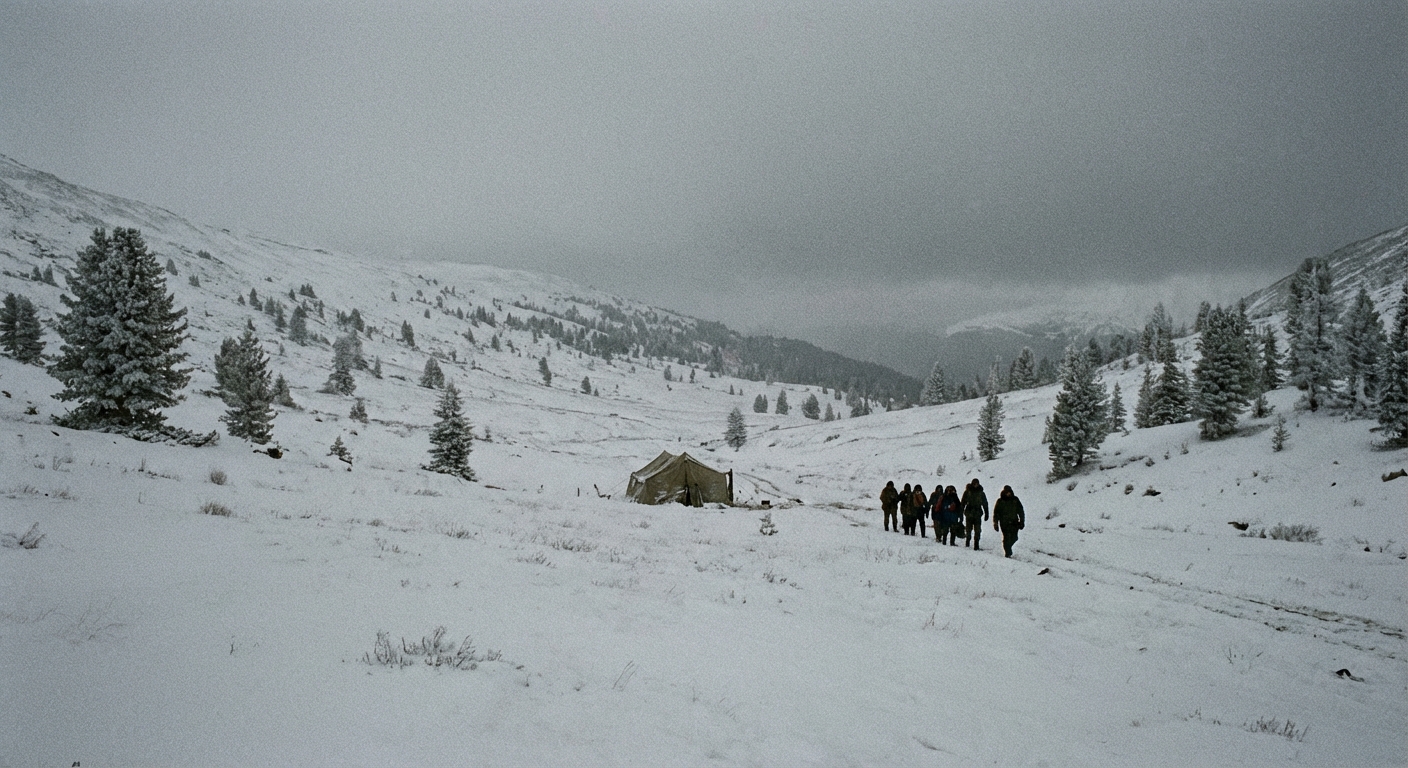
Intro: This verdict examines the claim that the deaths of nine hikers at Dyatlov Pass in February 1959 were subject to an official cover-up. The discussion treats the idea as a claim (not a fact), summarizes the most relevant documentation, highlights where sources conflict, and identifies what cannot currently be proven.
Verdict: what we know, what we can’t prove
What is strongly documented
• Nine members of an Ural Polytechnic Institute hiking group died on or shortly after the night of 1–2 February 1959. Their bodies were found at different locations on the slope and in nearby woods, and official 1959 investigative material and later summaries record a mix of hypothermia deaths and three victims with severe internal injuries.
• Multiple official and scientific reviews since 1959 have produced competing assessments. In 2019–2020 Russian prosecutors re-opened a review and in July 2020 presented a conclusion that a natural snow event (a slab/partial avalanche and related weather) was the most plausible explanation; that conclusion has been reported by mainstream outlets and summarized by prosecutors.
• Independent peer-reviewed scientific work (notably a 2020–2021 study in Communications Earth & Environment by Gaume, Puzrin and colleagues) modeled slab-avalanche dynamics at the tent site and concluded a snow slab impact is a plausible mechanism that could force occupants to evacuate suddenly and could produce some of the observed damage patterns under specific, atypical circumstances. Subsequent field expeditions documented that slab avalanches can and do occur at the site.
What is plausible but unproven
• That some combination of a slab avalanche, hypothermia, and chaotic flight from the tent explains the majority of deaths is a plausible scenario supported by modeling and by the 2019–2020 prosecutorial review — but the scenario requires several specific conditions (slab geometry, timing, unusual tent placement, subsequent movements) that are inferred rather than directly recorded in primary 1959 evidence. The peer-reviewed modeling shows plausibility, not historical certainty.
• That information or testimony was intentionally suppressed by Soviet-era authorities remains plausible as a historical pattern in some cases from the period, but the direct documentary evidence proving a deliberate, coordinated cover-up specific to the Dyatlov case (for example, explicit orders, sealed court files with incriminating text, or authenticated directives) has not been made publicly available. Existing archival fragments, interviews, and later summaries show gaps and inconsistencies but do not provide a smoking-gun proof of an organized, successful cover-up.
What is contradicted or unsupported
• Strong claims that the hikers were victims of a foreign weapons test, an aerial bomb or parachute mine, a covert KGB operation, extraterrestrial activity, or an otherwise high-energy external blast lack corroborating primary evidence in official records and peer-reviewed analysis. Several proposed mechanisms were explored by researchers and journalists over decades, but none has produced direct, verifiable forensic proof that withstands scrutiny.
• Claims that radiation levels on clothing demonstrate an explosive or military event are not supported by the limited forensic notes (which reported traces of beta activity on some garments) in a way that definitively ties them to specific modern hypotheses. The presence of trace radioactivity in some items has been repeatedly noted in secondary accounts, but does not by itself identify a source or prove a controlled cover-up linked to weapons testing.
Evidence score (and what it means)
- Evidence score: 28 / 100
- Documentary baseline: substantial original 1959 police and autopsy notes exist in fragments or summaries, but complete primary files and an unbroken paper trail are not publicly available, reducing verifiability.
- Independent scientific modeling supports an avalanche/slab hypothesis as physically plausible, increasing documentation quality for that explanation.
- Official 2019–2020 prosecutorial review publicly favored a natural explanation, which strengthens the documented narrative—but critics (including the Dyatlov Foundation) dispute completeness and interpretation of the review.
- Contradictory or sensational claims (weapons tests, secret experiments, deliberate murder) rely largely on circumstantial reading of injuries, local anecdotes, or gaps in the record rather than on irrefutable primary documents.
- Key missing elements (full, authenticated chain-of-custody of evidence; contemporaneous internal government directives; incontrovertible forensic linkage to a non-natural agent) are absent from the public record, which sharply lowers the score for cover-up assertions.
Evidence score is not probability:
The score reflects how strong the documentation is, not how likely the claim is to be true.
Practical takeaway: how to read future claims
• Treat extraordinary assertions (deliberate cover-up, secret weapons, covert agency killings) as demands for extraordinary evidence: authenticated, dated, provenance-controlled documents, or well-documented forensic traces with clear chain-of-custody. Absent those, weigh peer-reviewed modeling and contemporary official reports more heavily than retrospective rumor.
• Recognize that official conclusions (for example, the 2020 prosecutorial announcement favoring a snow slab/avalanche scenario) do not settle every detail and are open to reassessment if new, primary evidence appears. Critics and some family members have noted persistent questions that deserve archival scrutiny rather than amplification of speculation.
• Watch for three types of new evidence that would materially change the assessment: (1) authenticated archival materials showing deliberate suppression or orders to alter reports; (2) contemporaneous military or test records explicitly locating a weapons activity near the pass with time signatures matching the event; (3) modern forensics on preserved artifacts with proven chain-of-custody that produce unambiguous signatures inconsistent with natural causes. Until one of those appears publicly, cover-up claims remain insufficiently documented.
This article is for informational and analytical purposes and does not constitute legal, medical, investment, or purchasing advice.
FAQ
Q: What do the “Dyatlov Pass cover-up claims” actually allege?
A: The label covers several related assertions: that authorities intentionally suppressed evidence; that the incident was caused by a covert military or weapons test and then hidden; or that investigators misrepresented forensic results. These are overlapping but distinct allegations and should be evaluated separately against primary records.
Q: Did the 2020 Russian review officially close the case?
A: Prosecutors announced a conclusion in July 2020 favoring an avalanche/slab-and-hypothermia explanation; they presented that as a formal resolution of the criminal review. However, that decision has been contested by independent researchers and the Dyatlov Foundation, and it has not eliminated scholarly debate. An announcement is not equivalent to universal proof.
Q: Do scientific studies support the avalanche explanation?
A: Peer-reviewed modeling by Gaume & Puzrin (Communications Earth & Environment) found that a slab-avalanche scenario is physically plausible given certain assumptions about snowpack, tent placement, and slab geometry; follow-up fieldwork documented that slab avalanches can occur at the pass. Modeling strengthens plausibility but cannot supply eyewitness testimony or fully reconstruct the historical sequence.
Q: Was there evidence of radiation or blast injuries that point to a cover-up?
A: Some secondary reports and historical notes mention trace radioactivity on a few items and severe internal injuries on three victims. Those facts are recorded in various sources, but they do not automatically demonstrate a military blast event or a cover-up; experts argue multiple hypotheses could account for internal damage and trace radiation, and the existing forensic record is incomplete for definitive attribution.
Q: If I see a new sensational document or declassified memo, how should I verify it?
A: Check provenance (where did the file come from?), authentication (is the document stamped, dated, and matched to known archives?), and secondary confirmation (do multiple independent archives or credible scholars confirm the file?). Be wary of anonymous uploads without chain-of-custody or metadata. Verified archival finds would change the assessment; unverified leaks should not.

Science explainer who tackles space, engineering, and ‘physics says no’ claims calmly.