
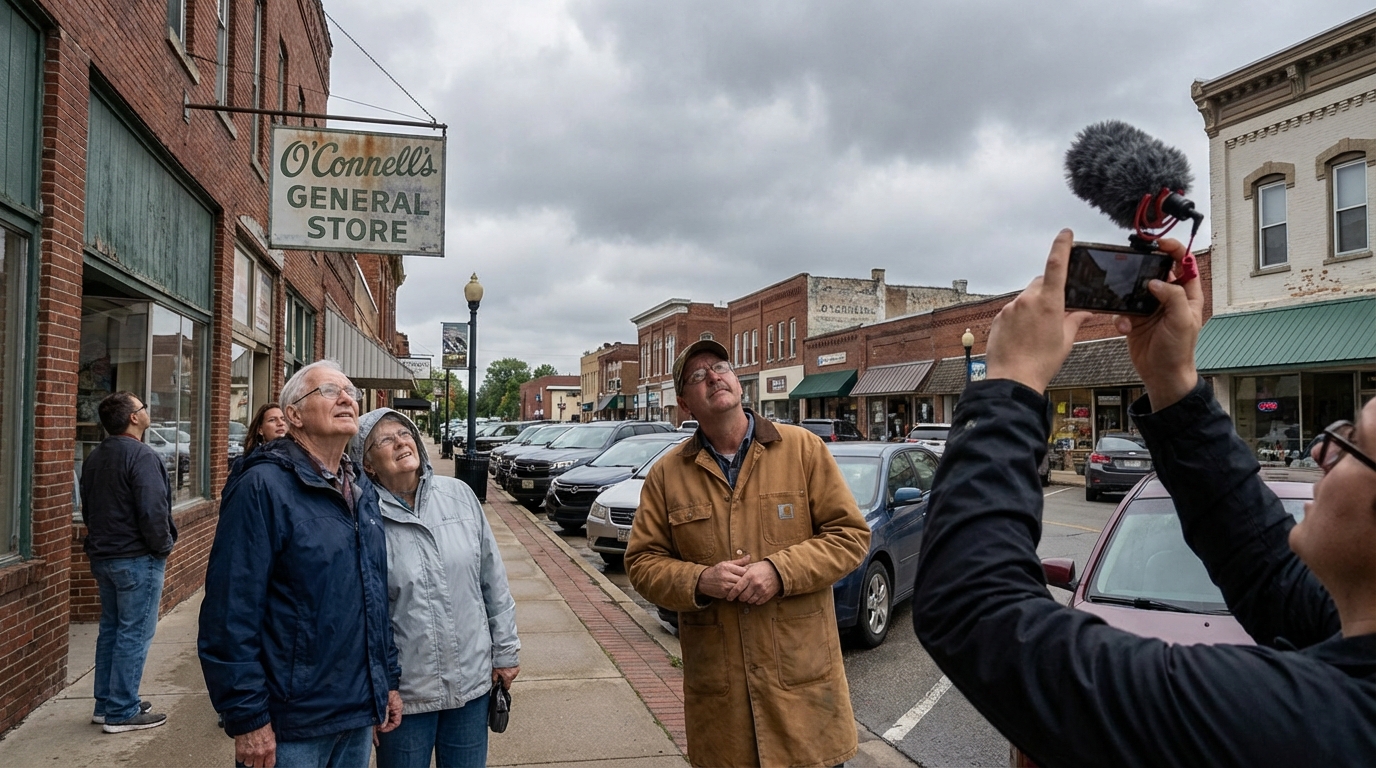
Scope and purpose: this timeline documents the public record and reporting around the Mysterious Sky Trumpets claims. It collects dated incidents, official statements or investigations, and major turning points in public debate. The goal is analytic and neutral: to show what is documented, what is disputed, and where the evidence is weak or absent. This article treats the subject as a claim and does not assume it describes a single phenomenon.
Timeline: key dates and turning points for Mysterious Sky Trumpets claims
- 2008 — Early video reports: a set of internet-hosted videos and local reports from places such as Homel and other locations appear online and are retroactively cited as some of the earliest modern recordings of trumpet-like sky noises; these items helped seed later attention but are often sourced to YouTube posts and blog aggregators rather than formal incident reports.
- August 2011 — Kyiv/Kiev, Ukraine: an urban recording circulated widely online in August 2011 and became a focal point for subsequent “sky trumpet” compilations; the Kyiv clips (and contemporaneous local coverage) are frequently referenced as the event that sparked the larger wave of reports. Some researchers treating these as primary examples note the recording’s distinct sound but also warn that many subsequent posts reused that audio.
- 2011–2012 — Clusters of local reports across North America and Europe: through 2012 several independent reports and videos (Montana, Alberta, Saskatchewan, midwestern U.S. towns and European clips) were posted to social media and news blogs; coverage mixed eyewitness accounts, on-site video, and speculation. Several clips later proved to be edited or reused audio in multiple uploads.
- January–August 2012 — Alberta/Conklin and other Canadian clips: videos attributed to Conklin and other Alberta locations circulated; investigators and skeptics later identified at least some uploads as likely dubbed or edited copies of earlier audio, and local fact-checks found inconsistencies in provenance for some clips.
- August 29, 2013 — Terrace, British Columbia: multiple residents recorded a loud whining/grinding/trumpet-like noise across the town. Local media covered the incident and the City of Terrace publicly suggested a municipal grader blade being straightened (maintenance work) could have produced the noise; the story became a widely cited example of a local official offering a mundane explanation for one cluster of reports. Coverage and video reposts kept the topic in public view.
- 2013–2016 — Periodic international spikes and repeat postings: similar reports and videos surfaced intermittently (including clips from the U.S., Europe, Australia, and Latin America). Blogs and aggregated lists tracked these events but often relied on user uploads, leading to mixture of authentic-sounding local recordings, audio-reused hoaxes, and editorialized commentary.
- 2019–2021 — “Mystery booms” and renewed scientific attention: scientists and journalists revisited the broader family of loud unexplained booms (often called “skyquakes” or “Seneca Guns” in the U.S.). The U.S. Geological Survey summarizes long-term reporting on mystery booms and lists common natural and human causes as well as instances that remain unexplained.
- December 2020 / AGU presentation — University of North Carolina preliminary study: researchers used regional seismic and infrasound data (the EarthScope transportable array) to compare documented reports in coastal North Carolina (the so-called Seneca Guns) to instrument records. They recorded atmospheric/infrasound signals associated with some reported booms and concluded many events are likely atmospheric pressure/airborne phenomena (bolide airbursts, sonic booms, ocean/atmospheric coupling) rather than classic tectonic earthquakes—but the dataset was not dense enough to identify a single universal cause. This work was reported in the scientific press and news outlets.
- 2020s — Continuing reports, mixed explanations, and improved monitoring: the phenomenon remains in public discourse. Scientists emphasize that “mystery booms” likely represent multiple mechanisms (airbursts/meteors, sonic booms from aircraft, industrial activity, cryoseisms/frost quakes, or small shallow seismic events that couple to the air) and that social-amplification and re-used audio have muddied the public record. USGS guidance and regional studies recommend cross-checking audio/video with seismic, infrasound, radar/space-object tracking, and local operational logs.
Where the timeline gets disputed
Disputes fall into three main categories:
- Authenticity of specific uploads: many widely-circulated videos reused the same sound file or were edited; researchers and skeptical investigators have flagged multiple clips as hoaxes or as re-dubbed footage that borrowed audio from earlier recordings. That means some entries in popular lists are not independent observations.
- Whether reports describe one single phenomenon: experts (and the USGS) point out that the label “sky trumpets” groups many acoustically similar but physically different events—e.g., sonic booms, distant explosions, cryoseisms, and atmospheric ducting of ordinary sounds—so treating the dataset as homogeneous is misleading.
- Local official explanations vs. persistent unknowns: some municipal or industrial explanations (for example, the City of Terrace’s grader/maintenance explanation for the 2013 cluster) address particular incidents but do not generalize to other events. Where officials have given a local cause, that may close the case for that location but does not resolve other reports with independent evidence.
Evidence score (and what it means)
- Evidence score: 28 / 100.
- Drivers that lower the score: heavy reliance in the public record on social-media video uploads (many of which reused audio or were later shown to be inauthentic); inconsistent provenance for many clips; few incidents with multi-instrument, peer-reviewed datasets linking sound, seismic, and atmospheric records.
- Drivers that raise the score: authoritative treatment of the broader category by the U.S. Geological Survey (which documents plausible natural and human causes) and recent seismo-acoustic work showing measurable infrasound/seismic signals for some events.
- The cluster of Terrace 2013 has documented local reporting and a municipal statement, improving evidentiary quality for that specific episode.
- Multiple independent cases remain unexplained at present; where objective sensor data exist they sometimes contradict simple interpretations.
Evidence score is not probability:
The score reflects how strong the documentation is, not how likely the claim is to be true.
This article is for informational and analytical purposes and does not constitute legal, medical, investment, or purchasing advice.
FAQ
Are the Mysterious Sky Trumpets claims verified?
Short answer: no single, globally verified phenomenon has been proven. The public record contains documented reports (audio/video, local news coverage, and some official statements) but also many videos with poor provenance or evidence of editing. Scientific work (for example, seismo-acoustic analyses of regional “Seneca Guns”) has identified measurable atmospheric signals for some events but has not produced a single causal explanation that covers all reports.
Which incidents are best-documented?
Well-documented items are those with independent verification: multiple recordings from different locations with timestamps that can be cross-checked against seismic, radar or local operations logs. Notable examples frequently cited in reporting include the Terrace, B.C. cluster (local coverage and municipal statement) and North Carolina “Seneca Guns” studies where researchers used transportable arrays to detect signals. However, even the best-documented events often lack a single definitive cause.
What explanations do scientists consider most plausible?
Experts and agencies list several plausible mechanisms depending on the case: shallow earthquakes or associated couplings that produce audible booms, cryoseisms (“frost quakes”), sonic booms from aircraft, meteors/bolide airbursts (sonic shock arriving after any visible flash), industrial or construction noises, and atmospheric ducting/amplification that carries distant sounds over long ranges. The USGS and recent seismo-acoustic studies emphasize multiple mechanisms and recommend instrument-based cross-checks for each incident.
How should investigators or witnesses document new incidents?
Take precise timestamps, secure multiple independent audio/video recordings from different vantage points, note weather/visibility, check local aviation and military activity logs, and compare to seismic and infrasound station data where available. Scientists stress that triangulation with at least three sensors (including infrasound microphones and seismometers) is needed to locate the source reliably.
Why do some people say these sounds are a hoax or a sign?
Social amplification explains much of the debate: early viral clips (notably the Kyiv 2011 upload) inspired copycat uploads and re-use of the same audio track, which spread fear and apocalyptic interpretations. At the same time, some legitimately recorded sounds remain unexplained. Skeptical investigators document numerous hoaxes and urge careful provenance checks; religious or conspiratorial readings exploit emotional resonance but do not replace physical evidence.
Where can I read the primary/official sources mentioned here?
See the U.S. Geological Survey primer on earthquake booms and Seneca Guns, the Live Science summary of the UNC/AGU preliminary research, and contemporary local reporting (e.g., Global News and Inside Edition coverage of Terrace, B.C.). Those provide primary documented statements and scientific summaries used in this timeline.

Science explainer who tackles space, engineering, and ‘physics says no’ claims calmly.