
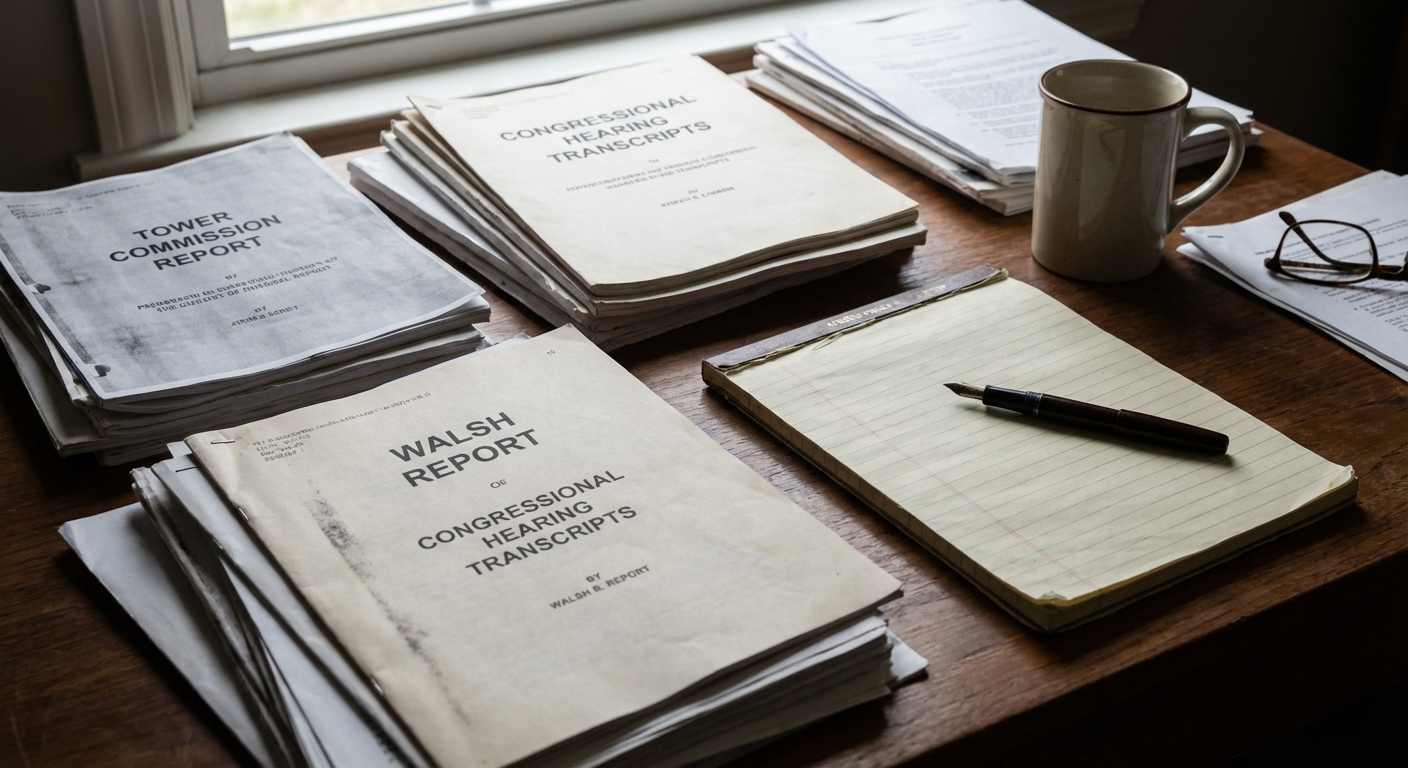
This timeline examines claims about the Iran–Contra Affair and its associated documents, focusing on a clear, source-cited chronology. It is organized to show when specific events and documents first entered the public record, which official reports support or dispute particular points, and where major disputes in the documentary record remain. This Iran–Contra Affair timeline prioritizes primary sources (commission reports, congressional records, and the Independent Counsel) and high-quality contemporary reporting to help readers evaluate the claim without assuming its truth.
This article is for informational and analytical purposes and does not constitute legal, medical, investment, or purchasing advice.
Timeline: key dates and turning points
- December 21, 1982 — Boland Amendment enacted (statutory constraint). Congress passed language (commonly called the Boland Amendment) that restricted U.S. appropriated funding for assistance intended to overthrow the Nicaraguan government; this legislative constraint is a frequent hinge in later claims about legality and circumvention.
- Late 1985 — Shipments of Hawk missile parts and initial Israel-linked transfers. Multiple shipments of Hawk missile parts and other materiel to Iran occurred in late 1985; contemporaneous and later official reviews document Israel’s role as an intermediary in some early shipments. These late‑1985 deliveries feature in claims that U.S. policy and agency actors were aware of or involved in arms movement to Iran.
- January 17, 1986 — Presidential “Finding” authorizing continued Iran contacts and some arms-related activity. Records and subsequent committee reports identify a presidential finding dated January 17, 1986 that authorized further clandestine contacts and operations related to Iran; this finding later became central to debates about what White House officials knew and authorized.
- Spring–Summer 1986 — U.S. direct sales, the development of the so‑called “Enterprise,” and internal memoranda. In early 1986 the program shifted toward direct sales from U.S. stocks and the creation of an off‑book network (frequently called the “Enterprise”) to move materiel and funds; internal memoranda from spring 1986 describe the planned diversion of proceeds to the Nicaraguan contras, which later investigators cited as documentary evidence of intent to reroute money.
- November 1986 — Public exposure and the Meese fact‑finding inquiry (Nov. 21–25, 1986). Press reports and Attorney General Edwin Meese’s short inquiry in late November 1986 brought the Iran arms shipments and, critically, an apparent diversion of proceeds to public attention; President Reagan made public statements in November 1986 admitting limited arms transfers while denying unlawful conduct, and Meese’s inquiry discovered an internal memorandum (April 1986) describing a $12 million diversion.
- December 1, 1986 – February 27, 1987 — Tower Commission established and report published. President Reagan convened a Special Review Board (the Tower Commission) in December 1986 to review National Security Council processes; the Commission’s report (published February 27, 1987) criticized failures of oversight and recommended administrative changes while documenting how NSC staff procedures contributed to the problem.
- January–August 1987 — Congressional investigations and televised hearings (multiple committees). Congress established House and Senate committees in early 1987; public hearings ran in spring and summer 1987 (notably May–August), producing live televised testimony (including Oliver North’s) and large committee records that shaped public understanding and subsequent legal reviews.
- November 1987 — Congressional committee reports published. The House and Senate committees released major reports in November 1987 that summarized findings, disagreed about levels of presidential knowledge, and documented withheld or altered documents, producing competing minority views as well.
- Late 1980s–early 1990s — Criminal prosecutions, trials, and appellate outcomes. Several administration officials were indicted and tried; convictions and sentences were obtained in some cases but several convictions were later overturned or vacated on appeal because witnesses’ testimony had been affected by immunized congressional testimony. Independent prosecutions and appeals stretched into the early 1990s.
- December 24, 1992 — Presidential pardons interrupt trials. President George H. W. Bush issued pardons on December 24, 1992 that ended pending prosecutions for several figures implicated in Iran–Contra (including former Secretary of Defense Caspar Weinberger), a decision discussed extensively in the Independent Counsel’s later reports.
- August 4, 1993 — Independent Counsel Lawrence Walsh’s Final Report published. The Independent Counsel’s Final Report (August 4, 1993) compiled investigative findings, described documentary evidence, and assessed prosecutorial outcomes; it remains a principal primary‑source compilation that researchers use to evaluate competing claims.
Where the timeline gets disputed
Even with extensive public records, the Iran–Contra Affair timeline contains several disputed nodes. Below are the principal areas of documentary or interpretive disagreement, with sources that represent the differing positions.
- Who knew what, and when — especially the President’s knowledge: Some congressional reports and witness statements indicate gaps or conflicting recollections about the President’s awareness of specific late‑1985 shipments and of the diversion of proceeds; the Tower Commission faulted NSC practices but did not produce definitive evidence that the President personally approved illegal diversions, while the Independent Counsel’s materials document evidence that investigators argued could implicate higher officials. Readers should note that official reports disagree about the strength of direct documentary proof on presidential knowledge.
- Timing and provenance of specific shipments (1985 shipments vs. 1986 direct U.S. sales): Reports agree that late‑1985 shipments involved Israeli transfers and that in 1986 the program shifted toward direct U.S. stock shipments, but some agency statements and memos differ on whether U.S. officials first learned of 1985 Israeli shipments only in 1986 or had contemporaneous knowledge. Those differences affect claims about prior awareness and intent.
- Extent and authorization of fund diversion to the Contras: Investigators located memoranda and financial traces indicating diversions of some proceeds to the Contras, but disputes remain about how much money, who explicitly authorized each transfer, and whether certain transactions were unlawful under the Boland restrictions. The Independent Counsel’s reports and congressional committee files lay out documentary and testimonial evidence but interpretive gaps remain.
- Document handling, destruction, and what was withheld: Committees and the Independent Counsel documented instances where NSC documents were altered, removed, or not preserved, and these actions themselves became points of contention in judging what can be proven from the surviving record. Disputes over whether evidence was deliberately destroyed or improperly handled affect the timeline’s clarity.
Evidence score (and what it means)
- Evidence score: 78 out of 100.
- Drivers: Multiple primary sources (Tower Commission, congressional committee reports, Independent Counsel) document arms shipments, the January 1986 presidential finding, the Meese inquiry, and documented memoranda about diversion.
- Drivers: Extensive contemporaneous journalism and committee transcripts corroborate the public exposure timeline (Nov 1986) and key hearings in 1987.
- Limitations: Central questions about high‑level intent and precise knowledge remain contested because of contradictory testimony, altered or missing NSC documents, and appellate decisions that restricted use of some testimonial evidence.
- Limitations: Legal outcomes (vacated convictions, presidential pardons) affect what was litigated and what was conclusively proven in court, reducing evidentiary closure on some claims.
Evidence score is not probability:
The score reflects how strong the documentation is, not how likely the claim is to be true.
FAQ
What does the Iran–Contra Affair timeline show about when the diversion of funds first became public?
The diversion of proceeds from some Iran‑related arms transactions to the Nicaraguan contras became publicly apparent in late November 1986 after Attorney General Meese’s November 21–25 inquiry and related press reporting; the Meese inquiry uncovered a spring 1986 memorandum describing planned diversions, and the public disclosures in November 1986 prompted the Tower Commission and congressional investigations.
How reliable are the primary documents (Tower Commission, Walsh report, congressional records)?
These primary documents are reliable as records of what investigators found, what evidence was produced to committees, and how investigators interpreted that evidence at the time; they vary in scope and purpose (e.g., the Tower Commission focused on process and oversight, congressional committees on legislative implications, and the Independent Counsel on criminal liability). Because these sources sometimes draw different inferences from overlapping documents, readers should treat them as complementary but not identical accounts.
Does this Iran–Contra Affair timeline prove who ordered illegal acts?
No single public document or trial outcome universally closed the question. Investigations produced documentary leads and witness testimony pointing to unauthorized diversions and cover‑up efforts, but appellate rulings, contested testimony, and presidential pardons limited final criminal findings about some high‑level figures. The record is strong on certain operational facts (shipments, memoranda, hearings) and weaker where documentary gaps or legal barriers leave open interpretations of who ordered specific illegal acts.
Where can I read the principal primary sources referenced in this timeline?
Key primary sources include the Tower Commission report (February 1987), the congressional committee hearing transcripts and reports, and the Independent Counsel Lawrence E. Walsh’s Final Report (August 4, 1993); many of these are archived online by government libraries and research projects. See the Tower Commission excerpts, congressional committee reports, and the Walsh Final Report for direct documentary material.
How should readers treat conflicting accounts in the timeline?
When reports or witnesses conflict, prioritize contemporaneous primary documents (signed memoranda, official reports, committee transcripts) and note whether testimony was later contradicted, immunized, or affected by document‑handling issues. This timeline highlights disputes and cites the underlying reports so readers can evaluate which documents are direct evidence and which are interpretive claims.

History-focused writer: declassified documents, real scandals, and what counts as evidence.