
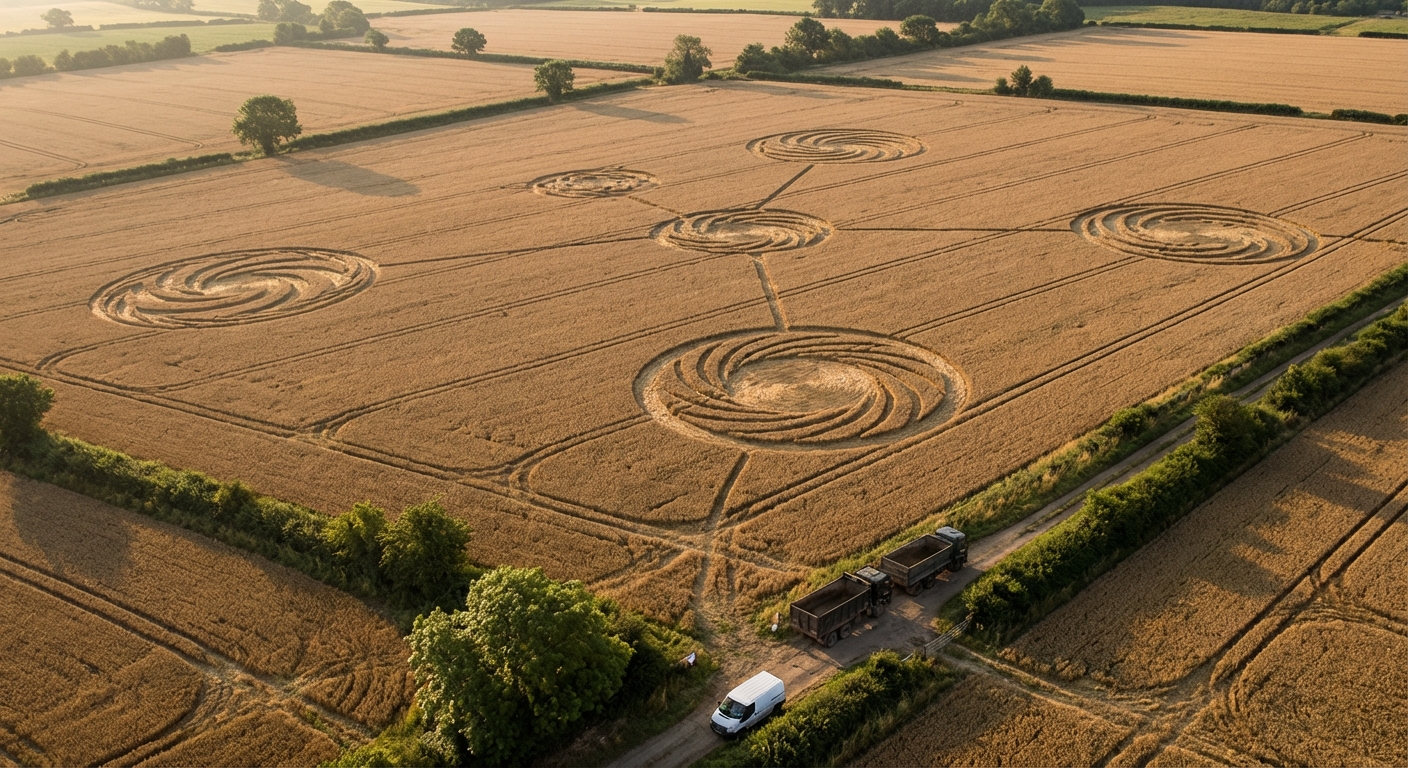
Scope and purpose: this timeline examines the claim framed as “Crop Circles: Hoax vs Unknown” by listing key dates, primary documents, and turning points. The goal is neutral, evidence-focused mapping: what is documented, what is disputed, and where reliable records end. The timeline uses primary press reports, peer-reviewed items, and skeptical reviews where available.
This article is for informational and analytical purposes and does not constitute legal, medical, investment, or purchasing advice.
Timeline: Crop Circles: Hoax vs Unknown — Key Dates and Turning Points
- 1678 — “The Mowing-Devil” pamphlet (earliest widely cited depiction). An English woodcut pamphlet published in 1678 depicts a devil mowing oats in a circular pattern; researchers use it as an early record of circular crop damage, though the text and image describe a cut field rather than modern flattened circles and have been interpreted in different ways.
- Late 19th–mid 20th centuries — sporadic reports. Various folkloric and natural-history accounts (e.g., on arcs, rings, or lodged patches) are sometimes cited by researchers as historical antecedents; these accounts are heterogeneous in description and often do not match modern geometrical pictograms. (See historical surveys and compilations.)
- 1970s — emergence of modern English formations; first widely cited modern cases. A cluster of simple circular depressions began to appear in southern England in the 1970s and early 1980s; the modern phrase “crop circles” was popularized in this period. Researchers and media began cataloging field reports and photographs.
- 1978 (commonly cited) — Doug Bower and Dave Chorley later say they began making circles. In later interviews they said they began creating simple circles in the late 1970s (often cited as 1978); they described using boards, ropes and simple sighting devices. Their later public statements and demonstrations became a pivotal turning point in public understanding.
- 1980s — escalation to complex pictograms (“pictograms”). Designs evolved from simple rings to multi-element pictograms during the 1980s and early 1990s; this shift increased media attention and academic curiosity about possible non-human causes while also attracting more human makers attempting to replicate the complexity.
- September 1991 — public confession by Doug Bower and Dave Chorley. Two Southampton men publicly told reporters they had produced many of the earlier English formations using planks, ropes and basic planning; the story ran in British and international press and led many scientists and journalists to view large numbers of circles as human-made hoaxes. Major news coverage documented the confession.
- 1994–1995 — peer-reviewed and non-mainstream laboratory reports claiming biophysical anomalies. Biophysicist W. C. Levengood published analyses reporting statistically significant anatomical differences (e.g., node swelling, changes in seed germination) in samples taken from certain formations; Levengood’s 1994 article is listed in Physiologia Plantarum. Subsequent BLT/Pinelandia team reports (and a 1995 Journal of Scientific Exploration paper) presented additional laboratory observations that some researchers interpreted as evidence of non-mechanical forces. These publications became focal points for debate.
- Mid–late 1990s — rise of organized human circle-makers and art collectives. Groups and individuals (often called “Circlemakers” or land-art practitioners) began acknowledging, demonstrating, or commissioning complex formations as art or performance, blurring lines between hoax/prank and intentional land art; public-facing collectives and later documentaries identified professional and amateur human makers producing large, intricate designs.
- July 1996 — “Julia Set” formation (Stonehenge area). One of the season’s most publicized large fractal/spiral formations appeared near Stonehenge in July 1996; the formation was widely photographed and discussed in both believer and skeptic communities as an example of a highly complex design. Its origin remains disputed in popular literature; some crop-community archives document it in detail.
- 1990s–2000s — skeptical reviews and methodological critiques of lab claims. Skeptical investigators and scientific commentators (for example, writers at Skeptical Inquirer and investigative researchers) reviewed Levengood’s work and other lab reports, raising methodological issues and arguing that many apparent anomalies could be explained by known biological mechanisms, sampling errors, or contamination. These critiques significantly affected how laboratories’ results were interpreted by mainstream science.
- 2000s–present — mixed picture: many confirmed human-made cases, contested lab claims, and ongoing small-number anomalies. After public confessions, artist statements, replicated human-made formations, and repeated skeptical reviews, the consensus in mainstream science is that most documented crop formations are human-made or have mundane explanations; however, a subset of samples and field reports (disputed and often small in number) continue to be cited by some researchers as anomalous and worthy of further study. Independent archives and community groups continue to document new formations worldwide.
Where the timeline gets disputed
Three main areas of dispute appear repeatedly in the documentary record and academic/press coverage:
- Which historical accounts count as “crop circles”? The 1678 “Mowing-Devil” pamphlet and other early references are used variably: some researchers treat them as antecedents, while skeptics note differences in description (mowed vs. flattened, location, scale). The interpretation of these sources affects claims about whether the phenomenon is new or recurring.
- Are Levengood/BLT laboratory findings robust and replicable? Levengood published a 1994 paper in a peer-reviewed plant-physiology journal reporting anatomical anomalies; supporters cite the statistical findings and lab observations as evidence that some formations show plant/soil changes not produced by mechanical flattening. Skeptical investigations and subsequent reviewers have raised methodological concerns (sampling, controls, possible contamination, and circular reasoning about what counts as a “genuine” sample), so these laboratory findings remain contested. Readers should note both the peer-reviewed publication and the detailed critical reviews.
- How many formations are demonstrably human-made? The Bower-Chorley confession and later documented work by artists and circle-makers show that many formations were and are made by people; mainstream sources treat the confession as a key turning point. However, the exact percentage of all worldwide formations attributable to hoaxing vs unexplained causes remains unsettled because of differing definitions and quality of archival records.
Evidence score (and what it means)
- Evidence score: 45 / 100
- Drivers: well-documented press confessions and artist admissions (strong documentation for many human-made formations).
- Drivers: peer-reviewed Levengood 1994 Physiologia Plantarum paper and other lab reports provide documented experimental claims (peer-reviewed publication increases score), but these are limited in scope and sample provenance is disputed.
- Drivers: sustained skeptical, methodological critiques and replicated human-made formations reduce confidence in broad non-human explanations.
- Drivers: small number of reported plant/soil anomalies remain in the literature and archives, but replication and independent confirmation are inconsistent.
Evidence score is not probability:
The score reflects how strong the documentation is, not how likely the claim is to be true.
FAQ
Q: What does the timeline for Crop Circles: Hoax vs Unknown show?
A: The timeline shows three clear strands: (1) historical and folkloric references that predate the modern era, (2) a documented rise of modern formations in southern England in the 1970s–1980s with a high-profile press confession in 1991 that many were hoaxed, and (3) subsequent scientific lab reports and skeptical critiques that produced conflicting interpretations. Major press and peer-reviewed items are cited above for each turning point.
Q: Are the Levengood plant/soil studies definitive evidence of a non-human origin?
A: No — Levengood’s 1994 peer-reviewed paper documents anatomical anomalies in certain sampled plants and has been influential, but methodological critiques (sample selection, controls, possibility of contamination, and difficulties in independent replication) mean the findings are contested. Some researchers regard them as evidence that merits further controlled study; others consider the results insufficient to establish a non-human cause.
Q: Did Doug Bower and Dave Chorley prove that all crop circles are hoaxes?
A: Their 1991 public statements and demonstrations showed that many earlier English circles could be and were made by people using simple tools; those confessions are well documented in press sources. However, the statement that “all” crop circles are hoaxes is not a documented conclusion in the peer-reviewed literature because some reported samples and field reports continue to be disputed and remain unresolved. The confession strongly supports a major human-made component to the phenomenon.
Q: If some formations show anomalies, what would clarify the record?
A: Transparent, contemporaneous sampling (with documented chain-of-custody), independent replication of plant/soil analyses, pre-registration of sampling protocols, and open data sharing would help distinguish mechanical/hoax effects from reproducible anomalous signatures. Currently, disagreements often relate to sample provenance and experimental control. Public, independently verified field studies with immediate scientific oversight would materially improve the record.
Q: Where can I find primary documents and reputable reviews cited in this timeline?
A: Key primary and review sources used here include the 1678 pamphlet (archival reproductions and public-domain reviews), mainstream reference summaries (e.g., Britannica), major press reports covering the 1991 confession, Levengood’s 1994 peer-reviewed paper (Physiologia Plantarum), BLT team publications, and skeptical reviews published in Skeptical Inquirer and similar outlets. Citations and links are provided throughout the timeline above.

Science explainer who tackles space, engineering, and ‘physics says no’ claims calmly.