
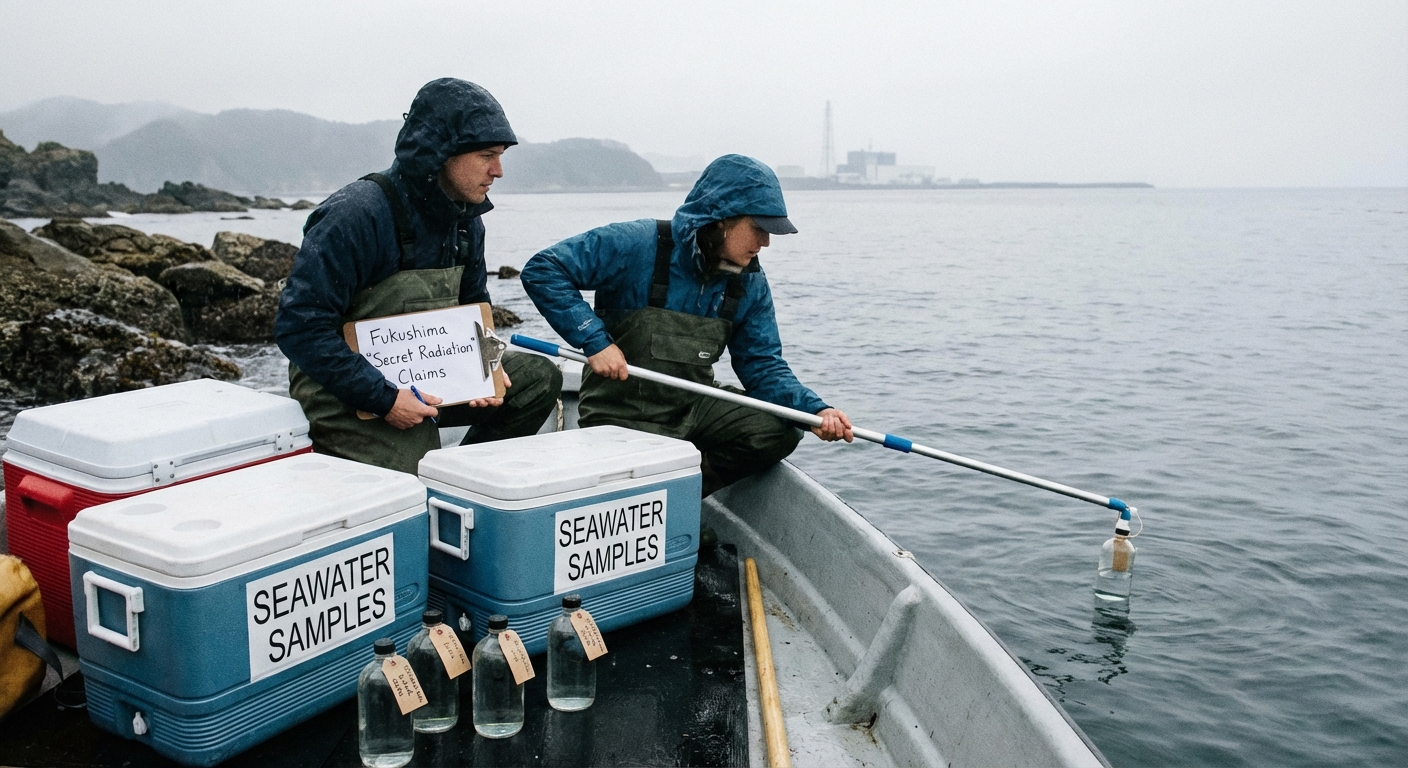
This timeline examines the claim commonly called the “Fukushima ‘Secret Radiation’ Claims” and traces key dates, documents, and turning points in public reporting and official reviews. The article focuses on documentation—official reports, peer-reviewed studies, investigative journalism, and legal or regulatory records—to separate what is recorded from what remains disputed or unproven. It uses the phrase “Fukushima secret radiation claims timeline” to describe the scope of sources and searches used below.
This article is for informational and analytical purposes and does not constitute legal, medical, investment, or purchasing advice.
Timeline: key dates and turning points — Fukushima secret radiation claims timeline
- 11 March 2011 — Great East Japan Earthquake and tsunami; meltdowns at Fukushima Daiichi. The earthquake and tsunami damaged reactors and emergency systems at Fukushima Daiichi, triggering releases of radioactive material and large-scale evacuations. Official international reviews and technical summaries mark this as the start point for all subsequent releases and monitoring.
- March–April 2011 — Initial atmospheric and marine releases; international detections. Early monitoring recorded airborne fission products outside Japan and measurable levels of isotopes such as iodine-131 and cesium-137 in air, rainwater, and seawater in Japan and abroad; multiple academic groups published environmental measurements documenting low but detectable levels overseas. These measurements established that some radioactive material was transported offsite and detected internationally.
- Spring–Summer 2011 — Citizen monitoring and local “hot spot” discoveries. Independent and citizen-led measurements identified localized high-activity “hot spots” (isolated patches of elevated cesium) in and around Tokyo and other areas far from the plant. Reporting by international outlets and local groups documented dozens of localized findings that were later investigated by authorities. These citizen discoveries fed claims that official monitoring had missed some localized contamination.
- 8 August 2011 — Investigative reporting alleges withheld data. Major investigative reporting in international outlets documented that some government-held monitoring data and radiological maps were not immediately released to the public, and raised questions about communication and transparency in evacuation planning. Reports described internal government data systems and timing disputes over what information was made public and when. These reports became a key reference point for later claims that authorities had concealed or downplayed radiation information.
- 2012–2013 — Early international assessments and scientific reviews. The UN Scientific Committee on the Effects of Atomic Radiation published a detailed assessment of levels and effects from the Fukushima accident, and the WHO and IAEA produced technical reviews about doses and health risks for exposed populations and workers. These official scientific reviews provided baseline dose reconstructions used to compare with both government monitoring and independent measurements.
- 2013–2019 — Scientific study of caesium-rich microparticles and localized deposition. Peer-reviewed and preprint studies (including materials published in 2019) identified and characterized small, highly cesium-rich microparticles emitted during the accident. Research showed these particles can create localized high-activity readings and have different physical and chemical behaviors than soluble radionuclides, complicating interpretation of monitoring data. Discussions of CsMPs influenced later debate about whether some measurements represented previously unrecognized exposure pathways.
- 2014–2021 — Continuing dose reconstructions and updates. UNSCEAR and other international bodies updated evaluations of radiation doses to workers and the public, and published FAQs and annexes refining earlier estimates of releases and their distribution. These updates remain central to authoritative statements about the scale and expected health effects of the accident.
- 2020–2023 — Legal actions, local disputes, and renewed scrutiny. Lawsuits by evacuees and fishermen, continued citizen monitoring, and contested interpretations of long-term monitoring data kept public attention on transparency and compensation issues. Some reports alleged delayed or confusing official communications; courts in Japan issued mixed rulings on government and TEPCO liability in related cases.
- 4 July–24 August 2023 — IAEA safety review and start of ALPS-treated water discharge. The IAEA published a comprehensive safety review of Japan’s plan to discharge Advanced Liquid Processing System treated water and, after national approvals, TEPCO began staged releases of diluted ALPS-treated water on 24 August 2023. The IAEA’s technical review concluded Japan’s approach was consistent with international safety standards and the discharge would have a negligible radiological impact, while noting ongoing monitoring and transparency obligations. The decision and the releases prompted international debate and legal challenges.
- 2023–2025 — Ongoing IAEA task force reviews and scientific discussion. Multiple IAEA missions during and after the discharge documented sampling and monitoring results that the agency described as consistent with operational limits and international standards; independent researchers and civil groups continued to call for broader data access, local monitoring, and transparency about long-term marine sampling and food-chain testing. At the same time, investigative pieces and newer scientific work revived questions about specific datasets and interpretations, keeping disputes alive.
Where the timeline gets disputed
Several points in the sequence above are the focus of continuing dispute. Three types of disagreement recur in public records and reporting:
- Did authorities delay or withhold monitoring data that mattered for evacuation decisions? Investigative reporting in 2011 and subsequent analysis documented instances where internal data or maps were not immediately released and where public messaging about risks and evacuation boundaries evolved rapidly. The reporting cites government data systems, timing gaps, and interviews with officials; official investigations and later international reviews acknowledged coordination and communication problems while not concluding deliberate concealment in most cases. These contrasting characterizations are a persistent source of dispute.
- Do localized “hot spots” or CsMPs imply a hidden higher public exposure than official dose reconstructions state? Independent measurements found isolated high-activity patches and researchers later described caesium-rich microparticles that can produce localized high counts. Official dose reconstructions (UNSCEAR, WHO, IAEA) use broad-area sampling and modelled dose pathways; they acknowledge localized heterogeneity but maintain that population-scale doses documented in their reports do not change substantially. Scientists and citizen groups disagree about how much localized findings change exposure estimates for specific individuals or places.
- Are recent investigative claims of concealment (for example concerning Tokyo fallout) supported by new documentary evidence? Some recent articles and analyses have argued that particular datasets or interpretations were downplayed; other authoritative reviews and follow-up missions emphasize transparency improvements and ongoing monitoring. Where sources conflict, the public record contains both investigative assertions and official rebuttals; the disagreement is factual and document-based rather than purely ideological, and it remains unresolved in parts. Readers should note when different sources use different datasets or measurement definitions.
Evidence score (and what it means)
- Evidence score: 62 / 100.
- Drivers: strong, dated primary documentation for the accident and large-scale releases (IAEA, UNSCEAR); peer-reviewed environmental monitoring confirming widespread low-level dispersion; credible investigative reporting documenting gaps in public communication; emerging scientific work that explains some localized anomalies.
- Limitations lowering the score: disagreement about the significance of localized findings, differing methodologies between citizen and official monitoring, and incomplete public release of some datasets and internal deliberations that would be needed to fully resolve concealment claims.
- What would raise the score: public release of full internal monitoring logs, contemporaneous communication records about evacuation decision criteria, or independent reproduction of disputed datasets with chain-of-custody documentation.
- What would lower the score: discovery that key cited datasets were misinterpreted, or that independently cited measurements lack provenance or peer review.
Evidence score is not probability:
The score reflects how strong the documentation is, not how likely the claim is to be true.
FAQ
Q: What does the “Fukushima secret radiation claims timeline” show?
A: It shows documented milestones (the 2011 accident, international dose assessments, citizen hot-spot discoveries, and the 2023 ALPS-treated water discharge) and indicates where journalistic investigations and scientific findings have raised questions about data release or interpretation. Official scientific reviews (UNSCEAR, IAEA) and peer-reviewed measurements are the backbone of the documented timeline; investigative reports and citizen monitoring mark the disputed nodes.
Q: Did scientists find particle types that change how monitoring should be interpreted?
A: Yes. Studies describing caesium-rich microparticles show that fallout included small, highly radiocesium-concentrated particles that can create localized readings higher than what would be expected from soluble cesium alone. That technical finding explains some isolated high-activity “hot spots” and is part of why some measurements from citizen groups and laboratories differed from broad-area government surveys. The significance for public-health dose reconstructions depends on exposure pathways and time spent at specific locations.
Q: Were government agencies proven to have intentionally hidden radiation data?
A: Investigative reporting found instances where internal monitoring data or maps were not immediately released, and later inquiries documented communication failures. However, the record contains both documented examples of delayed or limited public disclosure and official explanations citing confusion, data formats, or evolving understanding. Where assertions of intentional concealment are made, the public record usually shows contested interpretations rather than single, conclusive documentary proof of a deliberate, systematic cover-up. Readers should consult the cited primary reports and investigative pieces to see the specific documents and timelines in question.
Q: What primary documents are most important to review if I want to check these claims myself?
A: Key primary sources include UNSCEAR’s Fukushima reports (2013 and 2020/2021) for dose reconstructions, the IAEA status reports and ALPS-treated water review for official monitoring and technical assessments, peer-reviewed environmental monitoring studies that measured fallout in Japan and abroad, and investigative journalism pieces that cite internal government documents or timelines. Links and citations appear in the timeline above.
Q: Will more evidence likely become available that resolves disputes?
A: It is possible. Several contested elements rely on either internal contemporaneous records (communications, monitoring logs) or on localized measurements whose provenance or chains of custody are patchy. Ongoing research, legal discovery in related lawsuits, or further releases of archival government data could clarify disputed points; conversely, inconsistency in archived records could leave some questions open. Continued independent sampling (including marine monitoring after ALPS releases) and transparent publication of methods and raw data would materially improve the ability to confirm or refute specific allegations.
Summary: The claim labeled here as the “Fukushima ‘Secret Radiation’ Claims” is anchored in documented events—an accident with measured releases, independent measurements showing localized hotspots, and investigative reporting that documents gaps in public communications. Authoritative bodies (UNSCEAR, IAEA, WHO) have produced detailed dose reconstructions and safety assessments that form the main documented record; independent measurements and journalistic investigations identify anomalies and transparency problems that are real but disputed in their significance. Where sources conflict, they generally conflict on interpretation, methods, or on whether delayed disclosure amounted to concealment. Readers who need to reach a conclusion about any specific allegation should consult the primary documents cited above and note which elements are documented, which are contested, and which rely on incomplete or non-peer-reviewed data.

Science explainer who tackles space, engineering, and ‘physics says no’ claims calmly.