
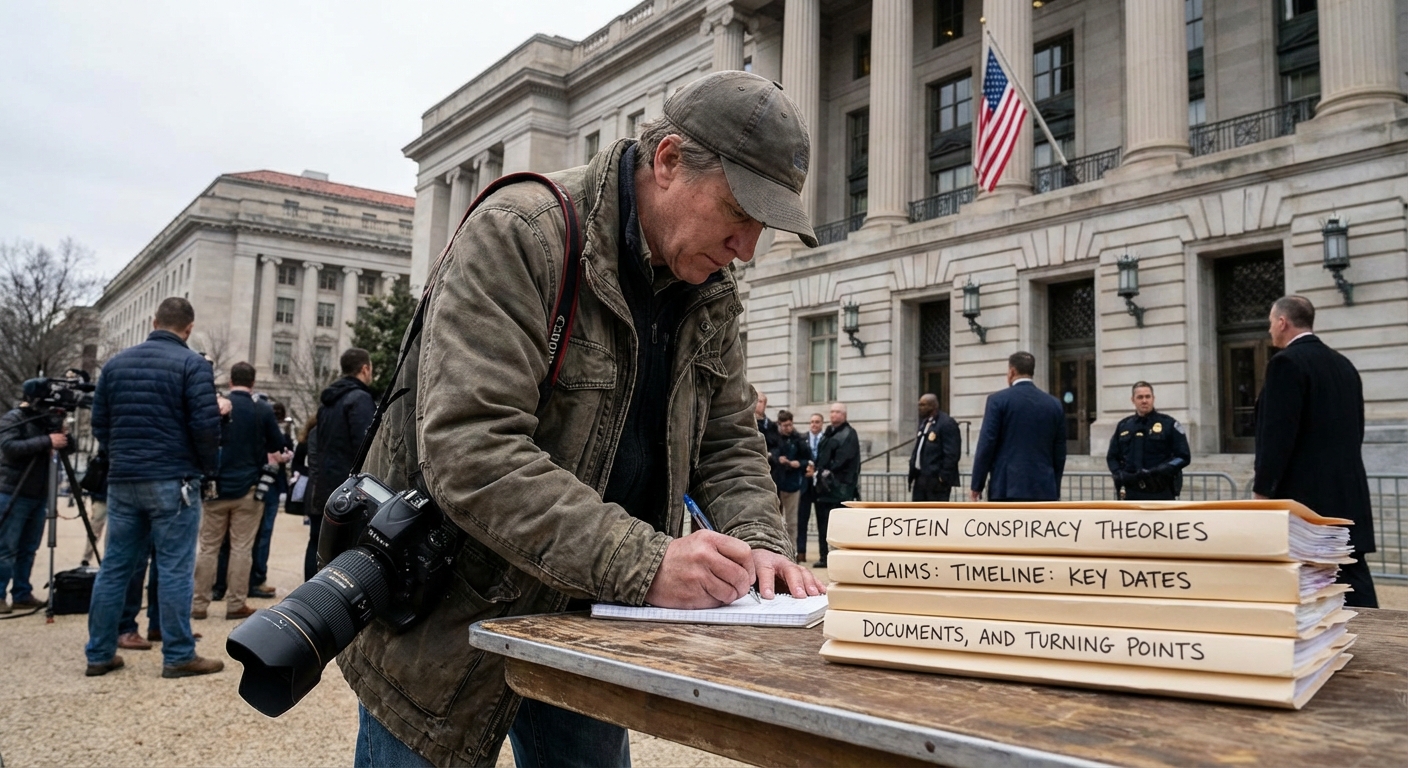
This timeline article examines the claim set commonly labelled “Epstein Conspiracy Theories” and maps the key dates, official records, court documents, and media turning points that supporters of those claims often cite. The goal is not to endorse or reject the theories but to show what is documented, what is disputed, and where evidence is missing or conflicted. This article uses the phrase “Epstein Conspiracy Theories timeline” as its organizing search term and scope.
Timeline: key dates and turning points
- 1996 — Early complaint reported to authorities: A woman (Maria Farmer) says she reported sexual exploitation involving Jeffrey Epstein and photographs years earlier; victims’ accounts and some records later referenced complaints in the 1990s. Source type: victim statements, media reporting and later unsealed files.
- 2005 (March onward) — Palm Beach police open a year‑long undercover probe: Palm Beach police began investigating after a parent reported a 14‑year‑old allegedly recruited to give Epstein a massage; investigators identified multiple underage victims during a 13‑month probe. Source type: police reports and longform reporting (Miami Herald).
- 2007–2008 — Federal/State prosecution and the controversial non‑prosecution agreement: Federal and state prosecutors negotiated a deal that resulted in Epstein pleading guilty in Florida to state charges in 2008, serving 13 months in jail with work release, and the existence of a federal NPA that restricted further federal charges at the time. Source type: court filings, the NPA, contemporaneous news reports.
- 2011–2014 — Civil suits and sealing/unsealing of records: Victims’ civil suits, sealing orders, and later unsealing motions created a patchwork of publicly available deposition excerpts and filings that would be cited later in media and congressional inquiries. Source type: court records and press coverage.
- 2018 (Nov–Dec) — Renewed media attention: Investigative reporting, including a high‑profile Miami Herald series, helped renew public attention and prompted federal review of past handling of the case. Source type: investigative journalism.
- 2019 (July 6) — Federal indictment and arrest: Epstein was arrested and federally charged with sex‑trafficking‑related offenses; he was denied bail and held at the Metropolitan Correctional Center in New York. Source type: federal indictment and news reporting.
- 2019 (July 23) — Reported cell injury and suicide watch episode: Reports indicate Epstein had a prior incident in his cell and was placed briefly on suicide watch before being removed from that watch and placed in special housing. Source type: Bureau of Prisons statements and reporting.
- 2019 (August 10) — Death in custody and autopsy ruling: Epstein was found unresponsive at MCC and later pronounced dead; the New York City Office of Chief Medical Examiner ruled the cause of death to be suicide by hanging. The death prompted FBI and DOJ investigations into the circumstances. Source type: official BOP statement, OCME determination, FBI/DOJ investigative announcements.
- 2019–2021 — Public debate, forensic opinions, and prosecutions of guards: Public debate followed the autopsy; a pathologist retained by Epstein’s family (Dr. Michael Baden) publicly questioned the suicide ruling on forensic grounds. Two MCC staff were later criminally charged for falsifying records related to inmate checks; charges had mixed outcomes. Source type: media reporting, court filings, OCME statements.
- 2020–2022 — Ghislaine Maxwell charged, tried and convicted: Maxwell, a close associate of Epstein, was arrested in 2020, tried in late 2021, convicted on multiple trafficking‑related counts (December 29, 2021), and sentenced in 2022. Source type: federal court records and trial reporting.
- 2023 (June 27) — DOJ Office of Inspector General report on MCC supervision: The DOJ OIG released a review that found “numerous and serious failures” by MCC staff that left Epstein unmonitored in the hours before his death, while noting it did not find evidence contradicting the FBI’s determination that there was no criminality associated with the death. Source type: DOJ OIG report.
- 2024–2026 — Massive document releases, transparency legislation and contested redactions: Congressional pressure and the Epstein Files Transparency Act led the DOJ to begin public releases of investigative files (including successive DOJ data set releases in 2025–2026). Releases drew criticism for heavy redactions, the temporary removal of some files, and ongoing disputes about victim privacy and judicial orders. Source type: DOJ disclosures portal and major media coverage.
- 2025–2026 — Continuing litigation, FOIA efforts, and new reporting from released files: Ongoing litigation over sealed materials, new media reporting on files and flight logs, and additional civil suits against Epstein’s estate and associated institutions kept the case in public view and generated fresh claims drawn from newly released records. Source type: DOJ datasets, court filings, press coverage.
Where the timeline gets disputed
Many disputes about the timeline stem from three related issues: (1) incomplete or sealed records that were only partially released later; (2) differences between official forensic conclusions and independent experts’ public statements; and (3) procedural and archival failures (camera outages, staffing lapses, and redactions) that create gaps people interpret as evidence for alternative hypotheses. Below are the main contested points.
- Cause of death and autopsy interpretation: The NYC Office of Chief Medical Examiner ruled Epstein’s death a suicide by hanging; an independent pathologist retained by Epstein’s family publicly argued some fractures were more consistent with homicide. Officially, the OCME has stood by its determination while debates among forensic experts have continued in public reporting. Source type: OCME statement and expert commentary.
- Prison procedure failures vs. criminal act: The DOJ OIG documented serious misconduct and dereliction by MCC staff that left Epstein unmonitored overnight. The same report noted it did not find evidence contradicting the FBI’s determination that no non‑BOP criminal actors were involved in Epstein’s death; nevertheless, the OIG findings are often cited by those alleging outside involvement because they show how Epstein’s death was possible in custody. Source type: DOJ OIG report.
- Missing or partially redacted documents: The DOJ has released multiple datasets under a transparency law, but releases have been heavily redacted, some files were briefly removed and the volume of documents (millions of pages) means important items may remain undisclosed or hard to find — leaving room for conjecture where records are incomplete. Source type: DOJ disclosures and media reporting.
- Interpreting flight logs, visitor lists, and third‑party references: Many documents and images referenced in released files mention numerous public figures; these items vary in provenance and context (photos, travel logs, depositions). Some released items are raw or unverified and have been misinterpreted in public discussion; others are substantive but redacted. Source type: DOJ releases and investigative coverage.
Evidence score (and what it means)
- Evidence score: 58/100
- Drivers of this score:
- Strong, high‑quality official documentation exists for many events (arrest records, indictment, OCME ruling, DOJ OIG report, court records from Maxwell’s trial).
- Large volumes of primary material have been produced or referenced (DOJ disclosure datasets), but many items are redacted, removed, or pending review, limiting completeness.
- Documented procedural failures at MCC are well‑sourced, but they do not constitute direct evidence of third‑party criminal intervention; official probes (FBI, OIG) reached differing emphases.
- Independent expert disagreement on forensic details (e.g., neck fractures) shows genuine technical uncertainty, not new documentary proof.
- Media reporting and investigative archives (Miami Herald, Guardian, etc.) supply context and leads, but some widely circulated claims rely on inference rather than primary documents.
Evidence score is not probability:
The score reflects how strong the documentation is, not how likely the claim is to be true.
FAQ
What does the Epstein Conspiracy Theories timeline show about the most disputed moments?
The timeline shows that the most disputed moments are (1) the immediate circumstances of Epstein’s death in custody (procedural lapses, camera outages and inconsistent guard records), and (2) gaps or heavy redactions in released investigative files that leave open questions about who knew what and when. Official sources document the failures (DOJ OIG) and the OCME’s ruling, but independent experts and advocates point to unresolved evidence gaps that are not yet closed by publicly available documents.
Are there primary documents people can read to verify events in this timeline?
Yes. Key primary sources include the DOJ’s Epstein disclosures portal (a consolidated repository of FOIA and related releases), the DOJ OIG report on MCC supervision, court filings from federal prosecutions and civil suits, and the NYC Office of Chief Medical Examiner’s autopsy finding. These are the documents journalists and researchers cite when constructing timelines.
Why do experts disagree about the autopsy and cause of death?
Forensic pathologists can reach different conclusions when evidence is ambiguous or when they place different weight on certain injuries (for example, hyoid bone fractures). The OCME concluded suicide by hanging, while a private pathologist retained by Epstein’s family publicly argued some injuries were more consistent with homicidal strangulation. That professional disagreement is documented in reporting, but it is not equivalent to a new, independently corroborated evidentiary finding that overturns the OCME ruling.
What would change the assessment of these conspiracy claims?
Significant, verifiable changes would include: the release of unredacted investigative records that show previously undisclosed evidence of third‑party criminal intervention; credible, corroborated forensic re‑analysis that changes the cause‑of‑death determination; or court filings that introduce new, reliable primary documentation contradicting the official record. Absent such items, disputes rest on interpretation of existing documents and procedural failures.
This article is for informational and analytical purposes and does not constitute legal, medical, investment, or purchasing advice.

History-focused writer: declassified documents, real scandals, and what counts as evidence.