
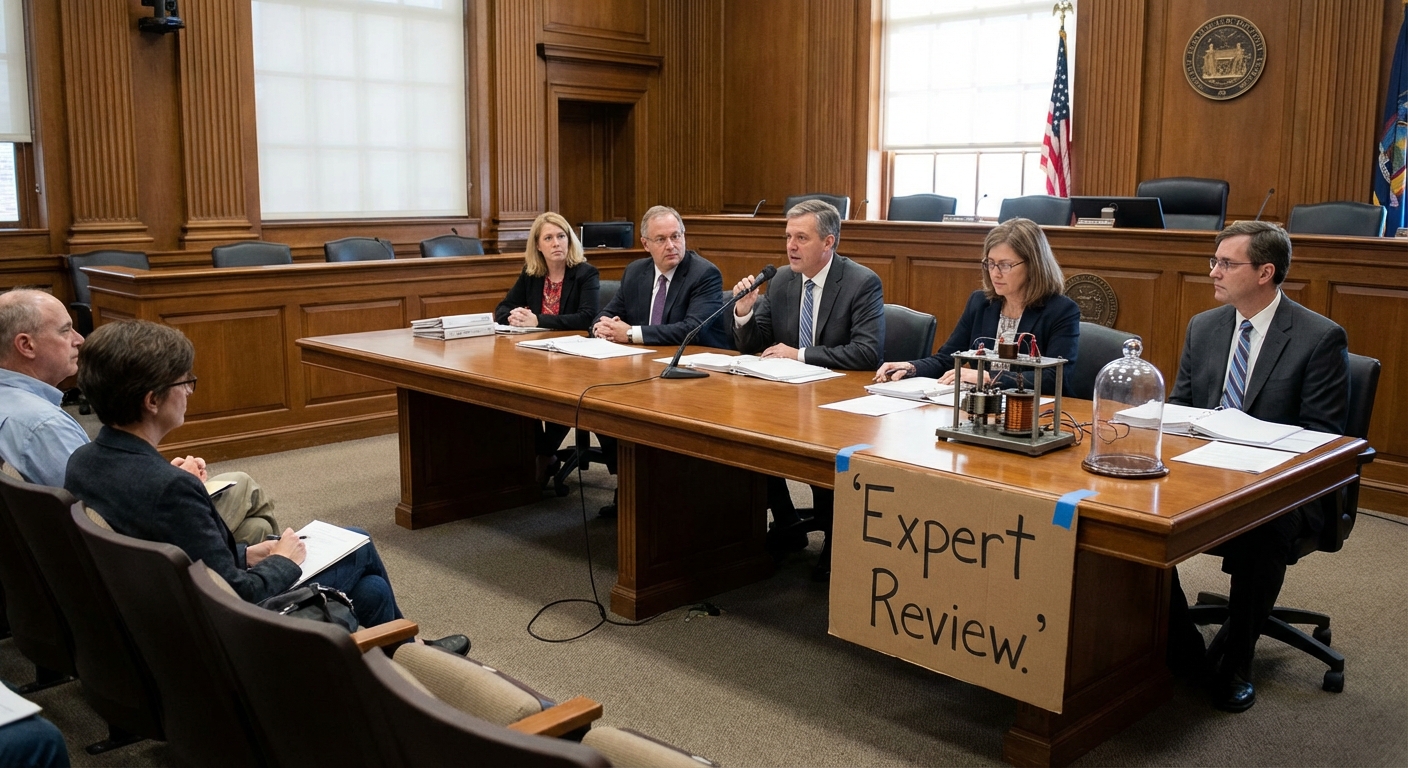
This article tests the claim commonly called “Free Energy Suppression” against the best available counterevidence and expert explanations. We treat “Free Energy Suppression” as a claim — not an established fact — and evaluate documented court rulings, demonstrations, scientific reviews, patent policy, and mainstream physics to determine which elements are documented, which are contested, and which lack evidence. The term free energy suppression claims appears below when discussing the claim itself and the literature that responds to it.
The best counterevidence and expert explanations
-
Fundamental physics: thermodynamics and perpetual-motion impossibility. Mainstream physics holds that perpetual-motion and over-unity machines violate the first and/or second laws of thermodynamics; these are not minor technicalities but well-tested constraints on energy conversion that explain why many purported “free energy” devices fail under independent testing. This is foundational counterevidence: any claim that a device yields net energy requires extraordinary experimental documentation because it contradicts established physical laws.
Why it matters: If a device truly produced sustained net energy without an external source, it would require reproducible measurements, open methods, and replication by independent labs — not only isolated demonstrations. Limits: The physics statement does not prove a particular inventor is fraudulent; it sets a very high evidentiary bar.
-
Documented failed demonstrations and investigatory findings (case examples). High-profile examples commonly cited in suppression narratives have been investigated and found lacking by courts, expert panels, or journalistic review. For example, claims around Stanley Meyer’s “water fuel cell” led to a 1996 civil legal finding that the device did not perform as claimed and that investor complaints described the device as using ordinary electrolysis rather than a novel, energy-producing process.
Why it matters: Court-appointed expert analysis and judgments are formal public records that directly contradict claims of revolutionary functionality in some widely cited cases. Limits: A legal finding of fraud addresses what a claimant presented and promised to investors or customers; it does not directly test every conceivable variant of an asserted new-physics idea, but it does weigh heavily on whether specific public demonstrations were credible.
-
Independent testing and public reviews of claimed devices. Several organized attempts to test alleged devices or their underlying theories have produced negative or inconclusive results. The Steorn/Orbo episode — where a small private company publicly invited scrutiny but failed to demonstrate a credible, independently verified energy gain and eventually ceased operations — is an illustrative recent example of pattern: public claim, invited tests, failure or non-replicable results, then continued promotional rhetoric rather than published, peer-reviewed proof. Coverage and scientific commentary recorded the failed demos and jury review outcomes.
Why it matters: Transparent, replicable testing is central to establishing extraordinary technological claims. Failure to pass independent tests strongly reduces the credibility of a claimed device. Limits: Not every failed demonstration proves bad faith; some failures reflect experimental error, premature claims, or poor engineering rather than intentional deception.
-
Scientific review process and replication standards (cold fusion history). The cold fusion episode (Fleischmann and Pons, 1989) shows how initial extraordinary claims can attract attention but then founder when independent replication and rigorous controls are applied; Department of Energy and other reviews concluded that claims were not convincingly demonstrated and that published work often lacked proper documentation, prompting withdrawal of mainstream support while leaving a small persistent research community. This episode is often invoked by both skeptics and suppression proponents, but official panel findings emphasize the centrality of replication and documentation over anecdote.
Why it matters: It demonstrates how the scientific establishment handles radical claims — by demanding reproducible evidence — and shows that lack of replication, not conspiratorial motive, usually explains failed acceptance. Limits: The DOE review also showed some scientific disagreement about anomalous reports; disagreements do not equal proof of suppression.
-
Patent law and examination practice (operability and utility tests). Patent offices will file applications but can and do reject patents for inoperative inventions or those lacking credible utility; the USPTO’s examination guidelines ask examiners to require evidence when operability appears in doubt (MPEP guidance on utility and inoperability). While secrecy orders can legally withhold some patent publications for national-security reasons, routine patent-examination policies and requirements for demonstrable utility explain many inventor complaints more prosaically than a broad suppression conspiracy.
Why it matters: The patent process establishes a formal channel for technical disclosure; rejections or requirements for evidence are structural filters rather than secret conspiracies. Limits: The patent system is imperfect; secrecy orders do exist and can delay public disclosure of some inventions for national-security reasons (see next point).
-
Patent secrecy orders are real but limited in scope. The U.S. Invention Secrecy Act allows agencies to impose secrecy orders on patent applications deemed “detrimental to national security,” and thousands of secrecy orders have been active in recent decades; advocacy groups and reporting have documented these orders and questioned their transparency. However, publicly available analyses indicate most secrecy orders concern military or dual-use technologies; secrecy orders do not, by themselves, demonstrate a coordinated, long-term campaign to suppress benign or civilian “free energy” inventions.
Why it matters: Existence of secrecy orders is often cited by suppression narratives; it is documented fact that some applications are withheld, but the documented pattern in public records centers on security-related technologies rather than on a broad program to suppress energy innovations for commercial advantage. Limits: Because secrecy orders are by definition restricted, it is often impossible to prove or disprove whether any particular withheld application relates to the claims; absence of documentation is not proof of a conspiracy.
Alternative explanations that fit the facts
-
Poor measurement or experimental error. Many apparent excess-energy results disappear when measurement methods, calibration, and controls are tightened. Independent replication is the standard remedy for distinguishing error from real effects.
-
Overstated or premature claims by inventors and entrepreneurs. Financial and promotional incentives can encourage optimistic public statements before an effect is proven; investor litigation or media exposés sometimes follow. Legal findings and investigative journalism have documented cases where demonstrations did not bear out commercial or scientific claims.
-
Selective publication and survivorship bias. Failed attempts rarely get the same attention as initial sensational claims, producing a skewed public record that can feed narratives of suppression even where the more complete record shows failure to replicate. Coverage of unsuccessful replications and formal reviews tends to be more technical and less viral than early claims.
-
Legitimate secrecy for narrow national-security reasons. Secrecy orders exist and can apply to energy-conversion technologies with military relevance; that administrative mechanism can delay or prevent public patenting in specific cases without implying a general commercial suppression campaign.
What would change the assessment
-
Public, well-documented experiments with open methods, raw data, and independent replication in accredited laboratories would be decisive evidence in favor of an extraordinary device. Replication across multiple independent labs is the standard scientific threshold.
-
Transparent, contemporaneous patent or legal records showing government secrecy orders explicitly applied to a documented working device (with non-classified technical summaries) would materially support claims of targeted suppression; currently, secrecy-order records show the mechanism exists but do not prove such a program directed at civilian “free energy” devices.
-
Credible whistleblower testimony corroborated with documentary evidence (lab notebooks, measurement logs, independent replication attempts) could change the balance — but unverified anecdotes are weak evidence compared with reproducible experiments.
Evidence score (and what it means)
- Evidence score: 22 / 100.
Evidence score is not probability:
The score reflects how strong the documentation is, not how likely the claim is to be true.
- The score reflects strong documentary counterevidence for specific, well-publicized cases (court rulings, failed demos, independent reviews).
- Mainstream physics provides a robust theoretical barrier that makes the claim extraordinary and demands extraordinary documentation.
- Government mechanisms (patent secrecy orders) exist and are documented, but public records show those mechanisms are mainly applied to security-related technologies, not a documented program to suppress civilian “free energy” inventions.
- Where independent expert review exists (DOE panels, scientific juries, court-appointed experts), the documentation tends to contradict sensational claims or finds the evidence insufficient.
- Gaps remain: secrecy is opaque by design, and some supportive anecdotal claims cannot be publicly verified; that uncertainty keeps the score above zero but well below a threshold for strong documentation.
This article is for informational and analytical purposes and does not constitute legal, medical, investment, or purchasing advice.
FAQ
Q: What are “free energy suppression claims” and are they documented?
A: “Free energy suppression” is a claim that governments, corporations, or other actors systematically hide or suppress working, low-cost, pollution-free energy technologies. The existence of the claim as an idea is well documented in public discourse, but documented, verifiable evidence that a coordinated, long-term program successfully suppressed working devices is weak: most cited episodes involve failed demonstrations, legal judgments, or limited secrecy orders — none of which prove a comprehensive suppression program.
Q: Do patent secrecy orders prove that free energy devices are being suppressed?
A: No. Secrecy orders are a documented legal tool that can delay or withhold patent publication when agencies judge disclosure detrimental to national security. Public records show thousands of secrecy orders over decades, mostly involving defense or dual-use technologies; the existence of the mechanism is factual, but it does not by itself prove targeted suppression of civilian free-energy inventions. Specific claims would require case-by-case documentary evidence linking secrecy orders to a demonstrably working device.
Q: Could mainstream science be wrong about thermodynamics and we just don’t know it yet?
A: Scientific laws are always provisional, but they are supported by vast experimental and theoretical evidence. If a new effect truly contradicted thermodynamics, it would need reproducible, independently verified experiments and a theoretical framework explaining prior successes of thermodynamic predictions. History shows that extraordinary claims require reproducible, open evidence; in the absence of that, the best current explanation is experimental error or misinterpretation rather than a wholesale failure of physics.
Q: What should someone do if they think they have a valid energy breakthrough?
A: Document everything: measurement methods, raw data, independent calibration, and protocols. Invite replication by credible, independent laboratories and publish methods and results in peer-reviewed venues. Seek appropriate patent protections but be prepared to provide evidence of operability to patent examiners; if national-security secrecy is invoked, seek legal counsel and understand that secrecy orders are rare and typically tied to defense concerns.
Q: Where do I find reliable information about specific claims and counterevidence?
A: Look for (1) peer-reviewed publications or formal agency reviews, (2) court records or documented expert testimony when legal cases exist, (3) credible journalistic investigations from established outlets, and (4) public records from patent authorities. Be cautious with anecdotal or unverified online claims; successful extraordinary claims are typically documented across several independent, authoritative sources. Examples used in this article include public scientific reviews, court records regarding the Stanley Meyer case, and documented journalistic and scientific coverage of Steorn and cold fusion.

Science explainer who tackles space, engineering, and ‘physics says no’ claims calmly.