
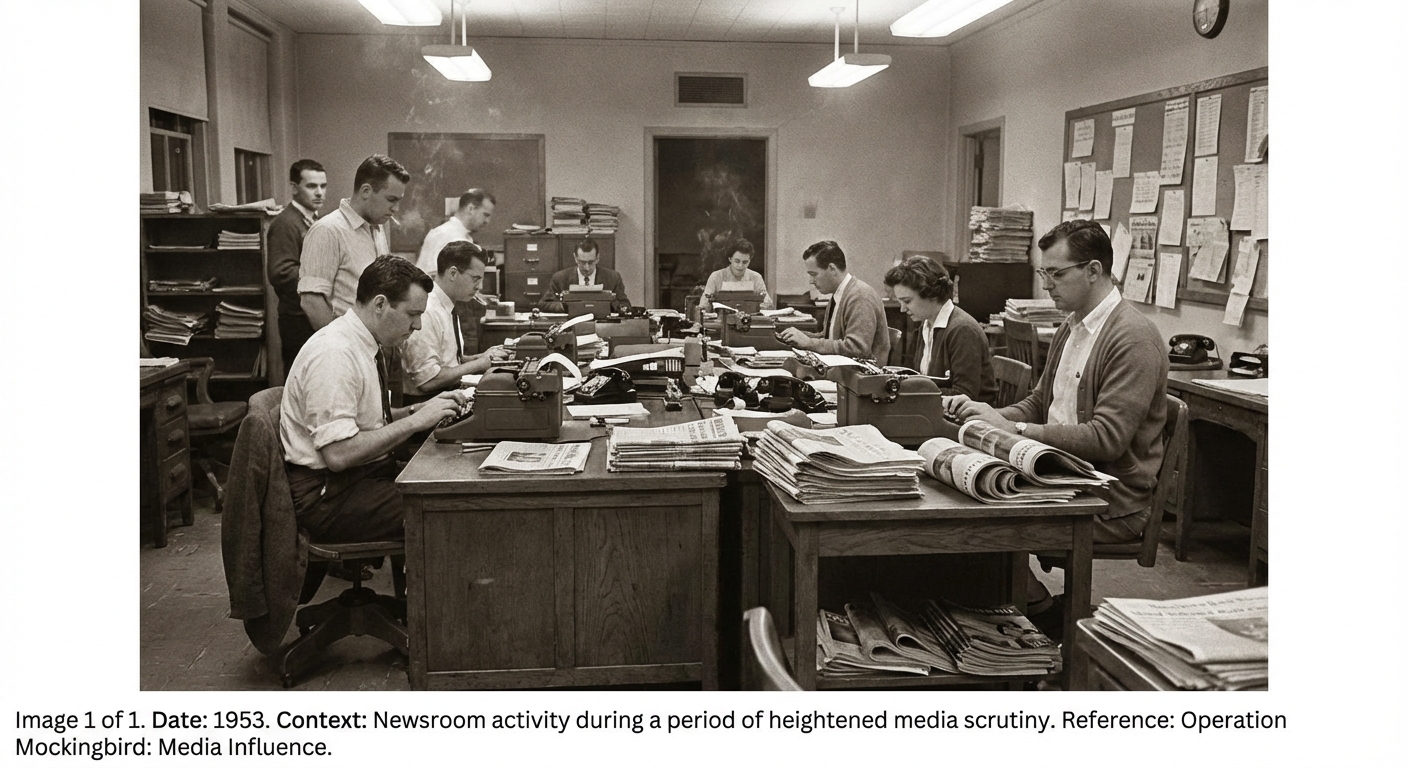
Scope and purpose: this timeline analyzes claims about “Operation Mockingbird” — the allegation that the CIA ran a broad program to influence U.S. and international media — by tracing key dates, primary documents, and turning points in public reporting and declassified records. It treats the subject as a claim under examination and uses declassified files, congressional reports, contemporaneous press accounts, and later historical studies to identify what is documented, what is disputed, and what remains unproven. The phrase “Operation Mockingbird timeline” is used below to organize the sequence of events and sources under review.
Timeline: key dates and turning points
- 1948–1952 — Creation and expansion of covert psychological/cultural operations (Office of Policy Coordination). Primary-source and institutional histories show the U.S. intelligence community created dedicated covert action and psychological-warfare structures in the late 1940s; Frank Wisner led early covert operations to influence foreign publics, including cultural programs.
- 1950 — Founding of the Congress for Cultural Freedom; later documented CIA funding. The CCF was created as a transnational anti-communist cultural organization; archival work and declassified materials show the CIA covertly funded and subsidized CCF activities and journals until exposure in the 1960s. The CIA’s role in funding the CCF is established in scholarly and declassified records.
- 1950s–1960s — Ongoing use of cultural fronts and covert funding for publications and organizations. Declassified histories and secondary scholarship document multiple CIA-funded front organizations and programs that supported cultural diplomacy and covert information work abroad; these activities provide context for later claims about press relationships.
- March–June 1963 — Project/”Project Mockingbird”: documented wiretaps of two syndicated columnists. The internal CIA compilation known as the “Family Jewels” includes a Project MOCKINGBIRD entry describing telephone intercepts of two columnists (identified in internal histories as Robert S. Allen and Paul J. Scott) between March 12 and June 15, 1963. This is a documented domestic activity involving surveillance of journalists.
- 1966–1967 — Public exposures of covert funding (New York Times series; Ramparts magazine revelations). Investigative press reporting in the mid-1960s exposed CIA covert funding of cultural and civic groups (for example, the Congress for Cultural Freedom and the CIA’s secret funding links to the National Student Association), leading to public controversy over covert U.S. influence efforts. These revelations are contemporaneous press sources and later archival confirmations.
- 1973 — “Family Jewels” compiled internally; later cited by investigators. In May 1973 the Director of Central Intelligence ordered a compendium of potentially problematic activities (the “Family Jewels”); the resulting internal files were later used by congressional investigators and partially declassified decades later. The Family Jewels includes references to domestic surveillance and use of journalists in specific operations (including the Project MOCKINGBIRD entry).
- 1974–1976 — Congressional investigations: Rockefeller Commission, Church Committee, and Pike hearings. Multiple executive and congressional inquiries in 1975–1976 examined CIA domestic activities and relationships with private organizations, producing reports that documented Agency relationships with journalists and civic groups while also limiting public naming of most individuals. The Church Committee concluded the CIA had cultivated relationships with journalists and reported the existence of dozens (the committee cited roughly 50 journalists with official but secret relationships according to its published summaries), but it did not publish a single de-labeled compendium naming every journalist publicly. These are primary-government reports.
- 1977 — Carl Bernstein’s Rolling Stone article expands on the congressional record and public files. Investigative reporting by Carl Bernstein (Rolling Stone, Oct. 20, 1977) used summaries of CIA files and interviews to describe hundreds of covert relationships between the CIA and reporters, correspondents, and foreign stringers; Bernstein framed this as a broader pattern but acknowledged limits in available documentation. This article is a major contemporaneous secondary source that amplified earlier findings.
- 1979 — Deborah Davis’ Katharine the Great introduces the specific “Operation Mockingbird” narrative into popular discourse. Deborah Davis’s unauthorized biography popularized a specific, detailed account that labeled a broad CIA press-influence campaign “Operation Mockingbird” and named senior media figures as participants; Davis’s claims have been widely cited in popular accounts but have been contested by historians for lack of verifiable sourcing. This is a contested secondary source.
- 2007 (and later) — Declassification and archival releases (Family Jewels release; CIA reading room files). Large portions of the Family Jewels and other CIA files were made available (with redactions) to archives and researchers in the 2000s; these releases confirm specific operations (e.g., wiretaps, secret funding of particular front organizations) but do not provide a single declassified document labeled “Operation Mockingbird” describing the wide-ranging program sometimes alleged in popular accounts.
- 2010s–2020s — Historical reassessments and scholarly work. Recent scholarship (for example, David P. Hadley’s The Rising Clamor) places the documented instances of CIA engagement with press and cultural institutions in context and critiques broad claims that the agency ran a single, centrally controlled program equivalent to popular descriptions of “Operation Mockingbird.” Other commentators and some primary files continue to be interpreted by critics and by those who see continuity in influence operations. Where sources conflict, historians and journalists point to gaps, classification, and differences in how the same records are summarized.
Where the timeline gets disputed
Three distinct disputes appear repeatedly in the literature and records:
- Scale and centralization: some accounts (notably Deborah Davis and later popular retellings) describe a single, centrally run, decades-long CIA program called “Operation Mockingbird” that recruited scores of leading domestic journalists and controlled editorial output. Scholarly and primary-source-focused accounts argue the records do not show a single documented program of that exact description; instead, they show a variety of covert cultural programs, targeted use of journalists and stringers abroad, specific domestic surveillance cases (e.g., Project MOCKINGBIRD), and ad-hoc relationships that varied over time. These contrasting readings of the same or related records are the central point of contention.
- Numbers and definitions: Carl Bernstein wrote that “more than 400” journalists had covert relationships with the Agency based on CIA file summaries; the Church Committee publicly documented roughly 50 journalists as having official but secret relationships (the difference reflects counting methods, the inclusion or exclusion of foreign stringers and non-staff contributors, and whether “cooperation” meant formal agreements or informal social contacts). Primary summaries used by investigators were often redacted or paraphrased for committee purposes, which complicates direct numeric reconciliation.
- Interpretation vs. documentation: primary declassified files (Family Jewels, station cables, and internal memos) document specific covert activities — wiretaps, funding of front groups, and use of overseas press contacts. Interpreting those activities as evidence of a single, coordinated domestic propaganda program depends on connecting discrete operations across time and geography; historians who have reviewed the archives caution that such connections are often speculative or unsupported by the declassified record. Where authors draw stronger conclusions, they sometimes rely on oral testimony, disputed memoirs, or secondary narratives that other researchers find unverified.
Evidence score (and what it means)
- Evidence score: 62/100
- Drivers of the score:
- + Clear primary documentation for specific covert activities: the Family Jewels and declassified CIA files document wiretaps, covert funding of cultural fronts, and relationships with overseas stringers.
- + Congressional-level scrutiny (Rockefeller Commission, Church Committee) produced formal findings that the Agency maintained secret relationships with journalists and civic groups, and those reports are primary-government sources.
- – Lack of a single declassified document that maps a centralized, long-running domestic program exactly matching later popular descriptions labeled “Operation Mockingbird.” Many scholarly reviewers note gaps between popular claims and the documentary record.
- – Redactions, destroyed or still-classified files, and reliance in some secondary accounts on interviews or contested memoirs reduce certainty about scale and internal coordination.
- – Conflicting contemporary summaries and different counting methodologies among investigators (e.g., 50 vs. 400+ figure disputes) lower confidence in quantitative claims.
Evidence score is not probability:
The score reflects how strong the documentation is, not how likely the claim is to be true.
FAQ
What does the Operation Mockingbird timeline show?
The timeline shows a documented pattern of CIA cultural and information activities (funding cultural fronts, using overseas press contacts, and in at least one documented case wiretapping U.S. journalists), plus major public exposures in the mid-1960s and congressional investigations in the mid-1970s. It does not produce a single unambiguous declassified document labeled “Operation Mockingbird” that demonstrates the exact, large-scale domestic propaganda program described in some later popular accounts; historians differ about whether the disparate records, taken together, amount to the program alleged by some authors.
Which documents are most important for verifying claims about Operation Mockingbird?
Key primary documents include: the CIA “Family Jewels” internal compilation (which contains entries such as Project MOCKINGBIRD), the declassified Church Committee reports and associated files, and contemporaneous investigative reporting (Ramparts, New York Times coverage in the 1960s, Carl Bernstein’s 1977 Rolling Stone piece). These are available in public archives or on agency reading-room sites and are the basis for most documented findings.
Why do sources disagree about how many journalists were involved?
Disagreements arise from differing definitions (formal asset, stringer, cooperating source, social contact), inclusion of foreign-based correspondents, redactions in the record, and the fact that CIA file summaries assembled for committees were sometimes paraphrased or anonymized. Carl Bernstein’s reporting relied on file summaries and interviews and presented higher estimates; the Church Committee published a more conservative, documented-number summary when it made public findings. Both sources are important, but they count different populations and use different standards of public naming.
This article is for informational and analytical purposes and does not constitute legal, medical, investment, or purchasing advice.
What we still don’t know
Important gaps remain because some CIA files remain redacted or withheld, and because oral histories and memoirs can conflict with written records. Specific unresolved questions include: whether a single centralized program matching some popular descriptions ever existed under that exact name; the full list of individuals and their precise roles (many names remain redacted or were not publicly released); and the extent to which overseas influence operations were mirrored by coordinated domestic editorial control rather than by ad-hoc or situational relationships. Researchers who wish to move beyond disagreements must continue to consult declassified agency files, archived congressional materials, and contemporaneous press records while noting the limits of each source.
Further reading and primary sources
- Selected primary records: CIA FOIA reading-room materials on Project MOCKINGBIRD and the Family Jewels.
- Congressional report: Final Report of the Select Committee to Study Governmental Operations with Respect to Intelligence Activities (Church Committee).
- Investigative journalism: Carl Bernstein, “The CIA and the Media” (Rolling Stone, 1977).
- Scholarly assessment: David P. Hadley, The Rising Clamor: The American Press, the Central Intelligence Agency, and the Cold War (University Press of Kentucky, 2019).

Geopolitics & security writer who keeps things neutral and emphasizes verified records over speculation.