
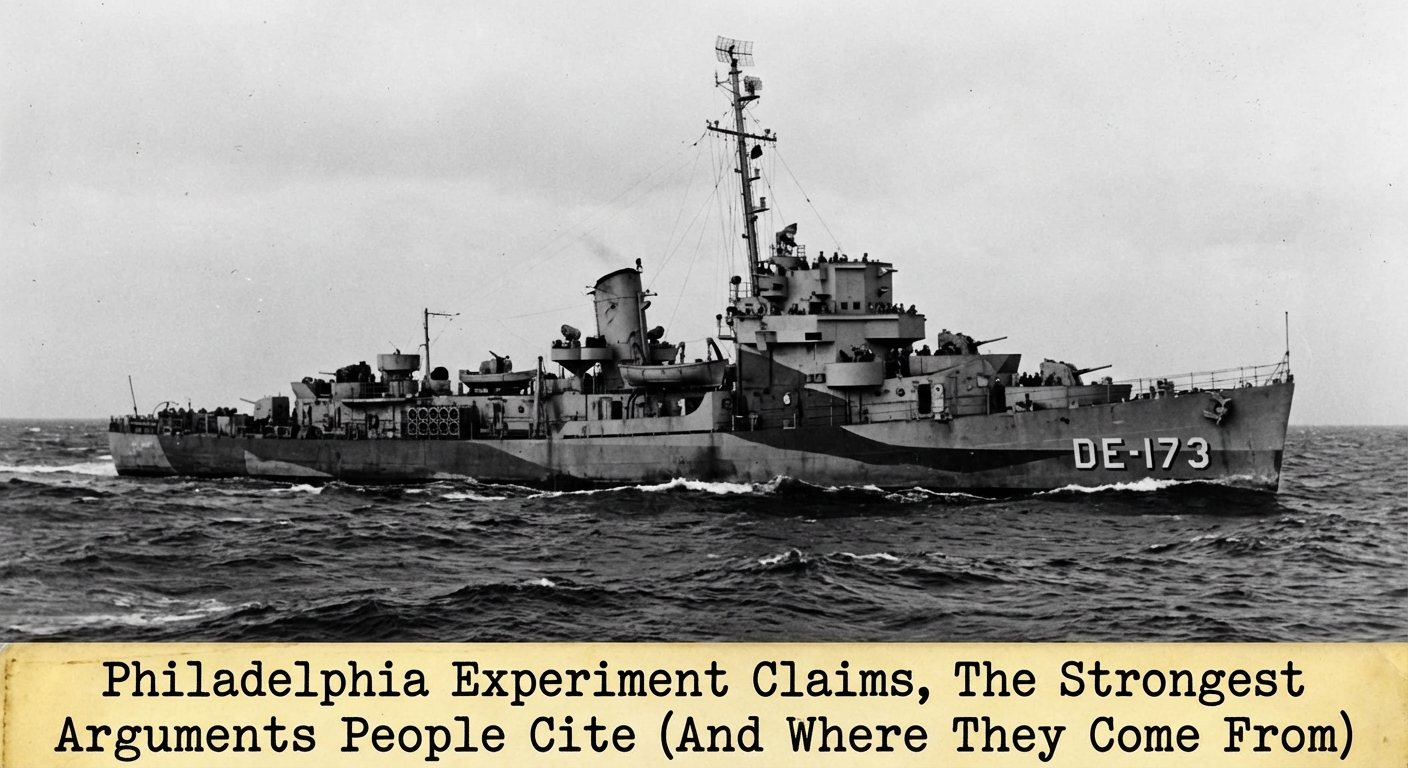
Intro: The items below summarize the arguments people commonly cite in support of the Philadelphia Experiment claims; they are presented as claims and not established facts. Where possible we link those arguments to their original source types and give concrete verification tests researchers, journalists, or archivists can perform to check them.
This article uses the phrase “Philadelphia Experiment claims” to refer to the body of allegations that a U.S. Navy ship (commonly the USS Eldridge) was made invisible and/or teleported in 1943. The best-known origin documents for those allegations are the so-called Allende/Allen letters and the annotated (“Varo”) edition of Morris K. Jessup’s book; those materials are central to many of the arguments below.
This article is for informational and analytical purposes and does not constitute legal, medical, investment, or purchasing advice.
The strongest arguments people cite
-
Claim: First-person eyewitness letters (Carlos Miguel Allende / Carl M. Allen) describe seeing a destroyer become invisible and briefly appear in Norfolk, Virginia. Source type: primary correspondence (handwritten/typed letters) sent to UFO author Morris K. Jessup in 1955–56. Verification test: examine the original letters and the attached annotations in the Varo edition; cross-check named merchant-ship movement reports and naval deck logs for the dates and ships the letter-writer cites.
-
Claim: The “Varo edition” — an ONR/Varo-reproduced, annotated copy of Jessup’s The Case for the UFO — gives the story an official-looking provenance, implying Navy interest or involvement. Source type: mimeographed internal reprint (the Varo edition) and related ONR material. Verification test: review the Varo edition print run, its ONR introduction and internal correspondence, and any ONR records that document distribution. Researchers can also request the exact reprint provenance from the National Archives or ONR records.
-
Claim: Crew injuries, deaths, or extreme medical outcomes (fused to bulkheads, insanity, burns) occurred after the experiment. Source type: alleged survivor testimony and later-retold anecdotes (books, interviews, pulp articles). Verification test: search USS Eldridge war diaries, deck logs, medical or casualty reports, and veterans’ service records; contact credible reunion or ship-association records; verify whether named crew lists and casualty entries exist in archival records. Not finding contemporaneous medical records or official casualty listings weakens this argument.
-
Claim: The SS Andrew Furuseth or other merchant ships witnessed the Eldridge appear near Norfolk. Source type: alleged merchant-ship movement reports and captain statements quoted in later retellings. Verification test: obtain the Andrew Furuseth movement report cards and the ship’s master’s statements from the National Archives and compare dates/positions with Eldridge deck logs. (Existing archival summaries indicate no corroborating observation by Andrew Furuseth on the dates claimed.)
-
Claim: The Office of Naval Research or Navy scientists took an interest in the Jessup/Allende material, implying classified testing. Source type: ONR involvement with Jessup and the existence of the annotated book; later ONR/Navy comments. Verification test: consult the ONR information sheet and Navy Operational Archives to see what ONR staff actually did, and whether ONR ever recorded or funded any degaussing, invisibility, or teleportation experiments in 1943. ONR/Navy records and public statements state there was no such program; ONR also notes it was not established until 1946, which complicates claims that ONR ran field tests in 1943.
-
Claim: A credible secondary literature (books by Berlitz & Moore, popular media, and later figurehead whistleblowers) corroborate the story. Source type: secondary books, magazine articles, conference talks, and films. Verification test: compare secondary accounts with primary documents (Allende letters, Varo edition, ship logs). Many later books expand or alter details and are often undocumented or rely on the original letters; those expansions should be treated as secondary storytelling rather than fresh primary evidence.
-
Claim: The phenomenon could be explained by advanced physics (Einstein’s unified field theory) or classified high-energy electromagnetic tests. Source type: speculative physical theory cited in Allende/Jessup correspondence and later authors. Verification test: consult peer-reviewed physics literature, archive records of wartime research, and documented degaussing technology to test whether the described mechanisms have any documented basis. Physics reviews show the described mechanisms (teleporting a ship or making it optically invisible by electromagnetic generators) are inconsistent with established physics and lack experimental documentation.
How these arguments change when checked
Summary: when the strongest-cited items above are compared to archival records and technical analyses, the narrative commonly claimed by proponents loses key anchors. The origin letters and the Varo edition are real documents and are the primary engines of the story — but they are uncorroborated by contemporaneous naval logs, convoy records, movement reports, or medical/casualty documents. Several systematic checks have been performed by researchers and archival offices; those checks produce consistent contradictions with the sensational elements of the claim.
-
Deck logs and war diaries: The Operational Archives (Naval Historical Center / Naval History and Heritage Command) summarizes Eldridge’s 1943 movements and reports the ship was not in Philadelphia on the dates usually claimed in the story. That archival record undercuts the scenario in which Eldridge vanished from Philadelphia and appeared in Norfolk on the same day. Researchers can order microfilm copies of the Eldridge action report and deck logs (NRS references are available).
-
ONR and provenance: The ONR/Department of the Navy information sheet documents that officers examined Jessup’s annotated copy and that a small Varo-reprint circulated; ONR has stated publicly that it has no record of conducting invisibility experiments in 1943 and views the outlandish claims as inconsistent with known physics. The Varo edition is historically important for understanding why the story spread, but ONR statements do not validate the extraordinary physical claims.
-
Allende / Allen record and reliability: investigative reporting and later research indicate Carl M. Allen (who wrote under Carlos Allende) was the primary source of the eyewitness narrative; Allen later gave contradictory accounts and reportedly made at least one confession of hoaxing, which he later recanted — a pattern that researchers describe as erratic and unreliable. That history weakens the evidentiary value of the letters as independent corroboration.
-
Alternative, mundane explanations: historians and technical reviewers have shown that degaussing and deperming technology — routine WWII procedures to reduce a ship’s magnetic signature — and experiments with generators producing corona discharge could explain perceived glows, instrument disturbances, or misremembered events without invoking teleportation or optical cloaking. Jacques Vallée and others have argued that confusion about degaussing and related tests provides a plausible origin for mythic elaboration.
-
Secondary literature and embellishment: later popular books and films added details (fused crew, time-travel, Einstein involvement) that are not present in primary letters or records. Where secondary accounts introduce new names, dates, or technical claims, those additions require independent sourcing; in many cases they cannot be sourced to contemporaneous documentation.
Evidence score (and what it means)
Evidence score: 18 / 100
- Primary-source existence: The Allende/Allen letters and the Varo-annotated Jessup book are extant and verifiable documents — that gives the claim an initial documentary anchor. However, an extant document can still be false or misleading.
- Corroboration by contemporaneous official records: Naval deck logs, war diaries, merchant movement reports, and veteran reunion testimony largely contradict the key movement and location claims attributed to USS Eldridge.
- Source reliability: the single-witness character of the most dramatic claims (primarily Carl M. Allen) and his later inconsistent statements reduce evidentiary weight.
- Technical plausibility: the physical mechanisms described (instant teleportation, optical cloaking at ship scale using 1943-era technology) have no documented experimental or theoretical support in peer-reviewed physics literature of the period or later analyses.
- Propagation & amplification: the Varo edition, later books, and film dramatizations explain how the story amplified despite weak corroboration; cultural propagation is well documented even when factual support is not.
Evidence score is not probability: The score reflects how strong the documentation is, not how likely the claim is to be true.
FAQ
Q: What are the strongest documentary sources that supporters point to for the Philadelphia Experiment claims?
A: Supporters most often cite the Allende/Allen letters sent to Morris K. Jessup in 1955–56 and the annotated “Varo edition” reprint of Jessup’s book. Those documents exist and are the historical origin of the modern claim; researchers then attempt to corroborate the letters’ details against naval deck logs, merchant movement cards, ONR statements, and crew records. The provenance of the Varo edition and the contents of the Allen letters are therefore the central documentary items to inspect.
Q: Do Navy records support the claim that USS Eldridge disappeared from Philadelphia and reappeared in Norfolk?
A: No. The Operational Archives and ship war diary summaries in the Naval Historical Center (Naval History and Heritage Command) indicate Eldridge’s movements in late 1943 did not match the story’s Philadelphia–Norfolk teleportation timeline; researchers can order the Eldridge deck logs and action reports from the archives for independent verification.
Q: Could degaussing or other wartime naval tests explain the Philadelphia Experiment claims?
A: Yes — plausible mundane mechanisms exist. Degaussing/deperming campaigns and experiments with shipboard generators could produce instrument errors, magnetic disturbances, and visible corona discharges or glows that might be misremembered or exaggerated by witnesses. Researchers such as Jacques Vallée have argued these routine or experimental procedures are a credible origin for the myth. But degaussing does not make a ship optically invisible nor teleport it; it only affects a ship’s magnetic signature relative to mines and sensors.
Q: Why did this claim persist despite archival contradictions?
A: The claim combines vivid eyewitness storytelling (the Allende letters), a tangible artifact with apparent official connection (the Varo edition), and dramatic retellings by popular authors and the film industry. Those elements — bright narrative, a seemingly official document, and cultural amplification — allow a claim to persist even when contemporaneous records contradict key details. The story also fits popular themes (secret wartime projects, hidden science), which helps it circulate.
Q: How should a researcher test a particular Philadelphia Experiment claim they read online?
A: Start by locating the primary source the claim depends on (Allende letters, Varo edition page citations, named crew lists). Then request contemporaneous archival material: the ship’s deck log and war diary from the National Archives / Naval History & Heritage Command, merchant-ship movement cards if a merchant ship is cited, and any ONR/Navy correspondence from the period. If technical claims are made about physics, compare them with peer-reviewed physics literature rather than popular summaries. When sources conflict, present the documents and note the exact points of disagreement rather than speculating.

Science explainer who tackles space, engineering, and ‘physics says no’ claims calmly.