
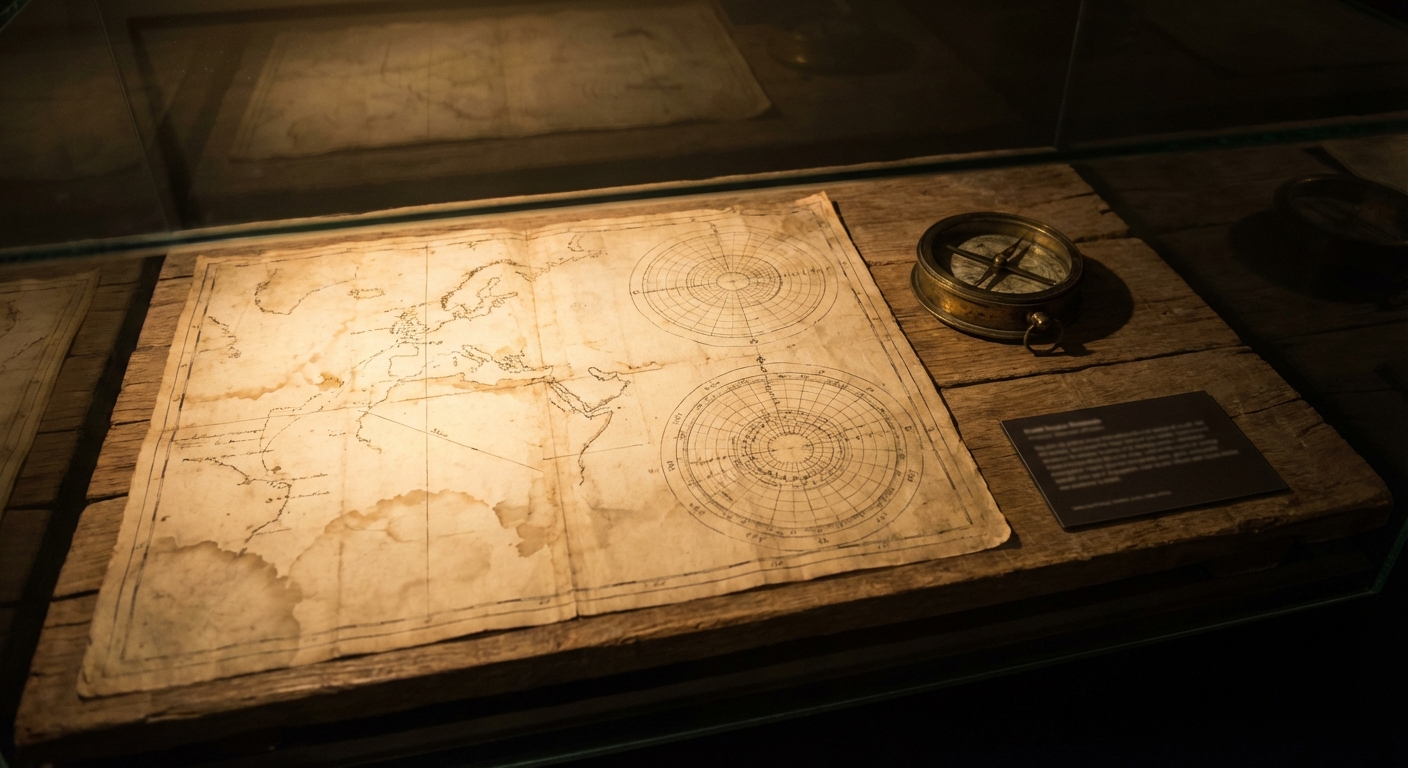
Below are the most-cited arguments used to support Hollow Earth claims. These are presented as arguments people cite, not as proof of the claim. For each, we note the type of source where it appears and a concrete test or record you can check to assess the claim’s documentation.
The strongest arguments people cite about Hollow Earth claims
-
Historical scientific proposals: influential early scientists sometimes proposed interior-world models.
Source type: historical scientific hypothesis (Edmond Halley, 17th century) — often cited as an origin point for Hollow Earth ideas.
Verification test: check primary historical work and scholarly histories of science to see Halley’s actual reasoning (magnetic puzzles, concentric-shell model) and the context that made it a speculative—rather than established—proposal. -
19th‑century pole‑opening narratives: John Cleves Symmes’s circulars and lecture tour arguing for polar holes and concentric shells.
Source type: pamphlets, public lectures, and popular press from the 1810s–1820s.
Verification test: inspect Symmes’s Circular No. 1 and contemporary press coverage; historians note Symmes promoted polar openings and concentric spheres, but his ideas were roundly ridiculed and never empirically supported. -
Explorer anecdotes and alleged diaries: circulated modern accounts attribute an interior‑Earth flight or encounters to polar explorers (most notably an alleged “Admiral Byrd” diary describing lush inner lands).
Source type: post‑war fringe books, magazine articles, and later online reproductions (e.g., Raymond W. Bernard and similar authors).
Verification test: check archival holdings (Byrd’s papers) and reputable archival statements; archivists report no authenticated Byrd record that substantiates the alleged diary narrative, and the diary’s provenance traces to mid‑20th century fringe publications. -
Misreadings of geophysical anomalies: people point to isolated or misunderstood geophysical findings (magnetic compass variation, old and unfamiliar polar navigation reports, or selective map anomalies) as evidence of openings.
Source type: reinterpretation or selective quotation of navigation logs, older scientific measurements, or unexplained local features in popular forums.
Verification test: compare the quoted observations with modern geodesy, magnetic‑field models, and global navigation data; modern geophysics explains magnetic variations and mapping quirks without invoking interior cavities. -
“Internal sun,” biota, or advanced civilizations: some accounts add an internal light source, ecosystems, or technologically advanced dwellers.
Source type: speculative folklore, pulp/occult literature, and later conspiracy books.
Verification test: look for independent physical measurements (seismology, gravity, direct borehole evidence, satellite remote sensing) consistent with a large internal luminous object or habitable cavity—none exist. -
Selective readings of older or fringe sources that appear scientific to non‑specialists: excerpts from 19th‑century pamphlets, occult books, or modern conspiracy sites are presented as evidence when they are in fact assertions or reinterpretations.
Source type: books and websites aimed at popularizing the idea rather than presenting reproducible data.
Verification test: check whether the cited material is primary (original measurement/log) or derivative (later interpretation or fictionalization); derivative sources typically fail independent verification.
How these arguments change when checked
Below we summarize what happens to each argument type when investigators consult primary archives, peer‑reviewed geophysics, and established institutional records.
-
Historical proposals: Halley’s concentric‑sphere idea and Symmes’s polar openings are real historical proposals, but they were hypotheses offered before modern seismology and gravimetry could test planetary interiors. These proposals are documented as proposals—useful for intellectual history—but they are not empirical support for the modern Hollow Earth claim.
-
Archival checks: the most famous modern explorer story (the alleged Byrd “diary” describing an inner world) is not corroborated by Byrd’s authenticated archives and is traceable to mid‑20th‑century fringe publications; archivists at the Byrd Polar and Climate Research Center indicate no authenticated materials that support the sensational diary narrative. That weakens the diary claim’s documentary basis.
-
Geophysics and seismology: modern seismic records show wave travel‑time patterns, shadow zones, and wave refractions that are consistent with a layered Earth (crust, mantle, liquid outer core, solid inner core). The pattern of P‑ and S‑wave arrivals led seismologists—most notably Inge Lehmann in 1936—to infer a solid inner core surrounded by a liquid outer core; that body of work is widely replicated and underpins current Earth‑interior models. These observations are incompatible with a planetary‑scale hollow cavity.
-
Gravity and density constraints: measurements of Earth’s mass and mean density require a distribution of mass that matches a dense interior (average density ≈5.51 g/cm³). A hollow model would produce gravitational and moment‑of‑inertia signatures inconsistent with satellite gravity maps, pendulum/gravimetry tests, and planetary formation theory. Those independent datasets constrain any large interior void to negligible sizes.
-
Remote sensing and modern mapping: satellites map Earth’s gravity field and topography with high precision; aerial and satellite imagery of polar regions, together with bathymetry and radar ice‑penetration surveys, have not revealed polar openings consistent with a passage to a habitable inner world. Claims that such openings are being suppressed do not match the open archival and scientific literature on polar surveys and Antarctic logistics.
Evidence score (and what it means)
- Evidence score: 8/100.
- Drivers:
- • Historical proposals from Halley and Symmes are documented (they exist as historical texts) but were speculative and predate modern tests.
- • Modern physical measurements (seismology, gravimetry, satellite remote sensing) strongly favor a layered, dense Earth rather than a planetary cavity.
- • The most‑cited modern “evidence” (e.g., Admiral Byrd diary narratives) trace to fringe publications with no archival corroboration; archivists report no authenticated supporting material.
- • The few factual kernels that proponents cite (magnetic anomalies, early navigation oddities) have conventional geophysical explanations; proponents’ reuse of these kernels does not bridge the gap to strong documentation.
- • Several narratives depend on unverifiable or secondary sources (books, web pages, and magazines that do not present raw data).
Evidence score is not probability:
The score reflects how strong the documentation is, not how likely the claim is to be true.
This article is for informational and analytical purposes and does not constitute legal, medical, investment, or purchasing advice.
FAQ
Do Hollow Earth claims have scientific support?
Short answer: no robust scientific support has been documented. The central physical measurements used by Earth scientists—global seismic wave records, gravimetric mass/density estimates, and satellite remote sensing—are inconsistent with a large, habitable hollow cavity inside Earth. Key seismological work (for example, Inge Lehmann’s analysis that led to the inner‑core model) and modern global datasets directly address the planet’s interior structure.
Where did the idea of a hollow Earth originally come from?
Variations of an interior‑world idea date back centuries. Edmund Halley proposed concentric shells in the late 17th century to explain magnetic anomalies, and in the early 19th century John Cleves Symmes promoted polar openings and concentric spheres in pamphlets and lectures. These contributions are historically documented but were speculative hypotheses in eras before modern geophysics.
What about alleged explorer accounts (for example, Admiral Byrd)?
Accounts that claim Admiral Richard Byrd entered a hollow interior rely on a contested or fraudulent diary and on books by mid‑20th‑century fringe authors; reputable archives holding Byrd’s papers do not authenticate the sensational diary narrative. Researchers who inspect primary Byrd materials and institutional records find no authenticated evidence of inner‑Earth encounters.
Why do Hollow Earth claims persist despite scientific refutation?
Several factors maintain the claim’s circulation: compelling narrative imagery (inner suns, hidden cities), reuse of historical names (Halley, Byrd, Symmes) that lend superficial authority, echoing across fringe publications and online communities, and a broader cultural appeal to secret‑knowledge narratives. That persistence is sociological and rhetorical; it does not substitute for new empirical evidence.
How could someone independently check a specific Hollow Earth claim?
Concrete verification steps depend on the claim: (1) for alleged diaries or explorer quotes, consult the original archival holdings (for Byrd, the Byrd Polar and Climate Research Center/Ohio State collections); (2) for alleged geophysical anomalies, compare the claim with peer‑reviewed seismology papers and global gravity/gradiometry datasets; (3) for map or photo claims, examine the original image metadata and cross‑check satellite imagery from reputable sources. If a claim’s documentation is limited to secondary or anonymous web pages, treat it as unverified until primary data are produced.

Science explainer who tackles space, engineering, and ‘physics says no’ claims calmly.