
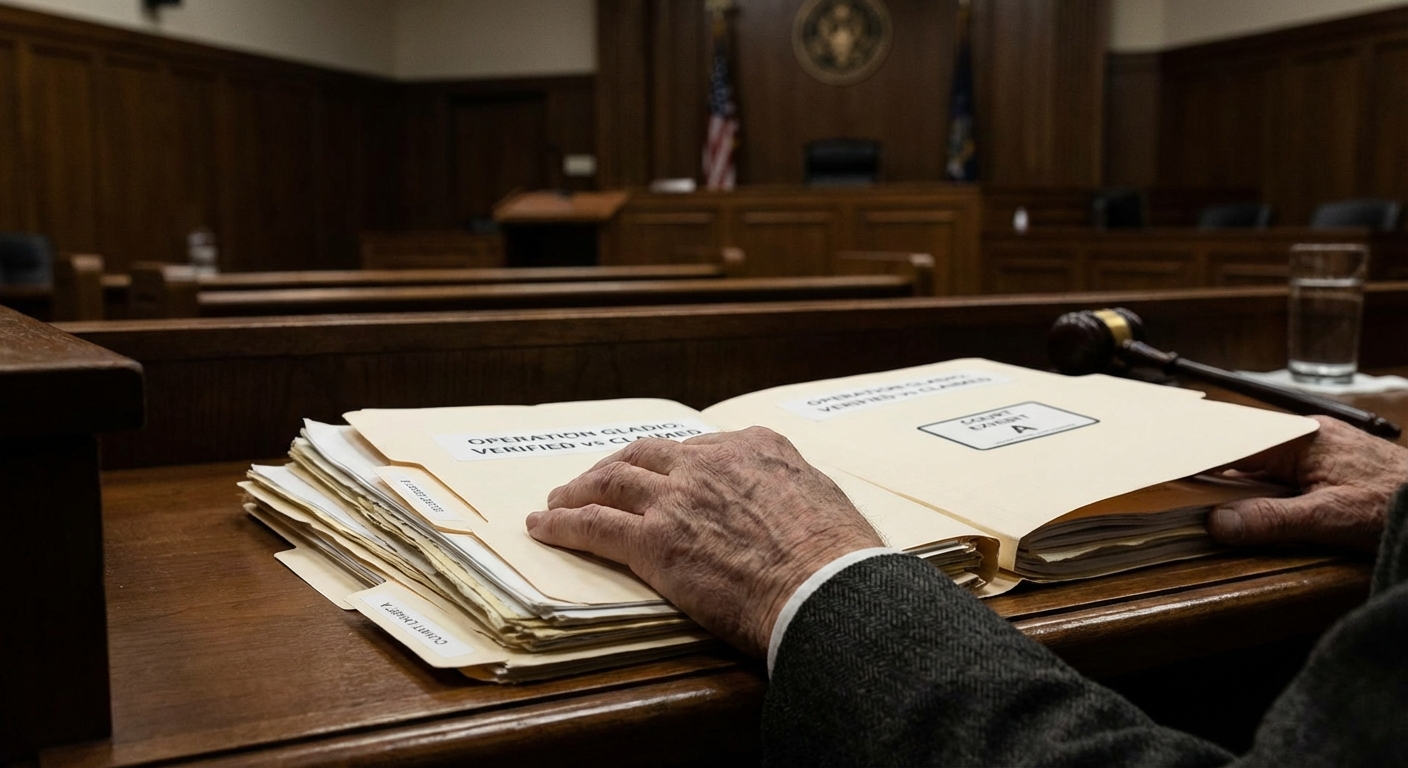
This counterevidence article tests the claim commonly described as “Operation Gladio” against the best available documentary records, court findings, official statements, and expert criticism. We treat the subject as a CLAIM: the goal is to separate what is clearly documented from what is disputed or inferred. The phrase Operation Gladio claims appears throughout because the article focuses on those contested statements and the evidence that supports or contradicts them.
The best counterevidence and expert explanations
-
Documented existence of NATO/“stay‑behind” structures, and the 1990 disclosure: multiple national authorities acknowledged secret stay‑behind networks in Europe after 1990; Italy’s prime minister publicly confirmed a clandestine structure (code‑name “Gladio”) on 24 October 1990. This disclosure is supported by contemporaneous press reporting and parliamentary records.
Why it matters: the documented existence of stay‑behind organizations establishes a factual basis for any further claims about their activities. Limits: official confirmation does not by itself prove the more serious allegations of state‑directed terrorism.
-
Judge Felice Casson’s investigations (Peteano case) found links between neo‑fascist perpetrators and irregularities in how some investigations were handled; Vincenzo Vinciguerra’s confession and later testimony identified right‑wing operatives and alleged protection from elements inside state services. These judicial findings and Casson’s later access to intelligence archives are widely cited in public records.
Why it matters: court records and judicial findings provide concrete, legally grounded evidence that specific attacks were carried out by identified actors and that investigatory failures or cover‑ups occurred. Limits: those findings do not automatically prove that NATO or the CIA ordered or directed those attacks.
-
Primary official denial/differing official narratives: the U.S. State Department (and other Western officials) have acknowledged the stay‑behind concept but have explicitly denied that the United States or NATO ordered, supported, or authorized terrorism by stay‑behind units; in public statements and subsequent communiqués the U.S. government described some allegations as rooted in disinformation and forgeries (for example, the Westmoreland Field Manual has been called a forgery by U.S. officials).
Why it matters: authoritative denials and contested documents affect how much weight to give claims that attribute direct responsibility to NATO/CIA. Limits: denials do not disprove all linkages, and some researchers argue denials are incomplete.
-
Academic and investigative disagreement about large causal claims: researchers and commentators disagree over whether a centrally coordinated NATO/CIA policy existed to carry out or direct domestic terror (a “strategy of tension”). Some scholars argue available documents and trials show connections between intelligence elements and right‑wing militants in specific cases; others caution that linking those cases into a single, centrally directed conspiracy requires inferential leaps and disputed source material. Noted debates and critiques appear in the scholarly literature and book reviews.
Why it matters: when reputable historians and intelligence scholars disagree, large claims require especially strong documentary proof. Limits: scholarly debate continues because primary archives remain incomplete in places and interpretations differ.
-
Direct documentary proof for some specific allegations is thin or contested: several widely cited documents used to support claims (for example the so‑called Westmoreland Field Manual in some narratives) have been judged by U.S. officials and some analysts to be forged or unreliable. Where a key document’s authenticity is in doubt, conclusions that rely heavily on it become unstable.
Why it matters: chain‑of‑custody, provenance, and independent verification of documents are central to historical claims; forged or dubious items can mislead even careful researchers. Limits: the presence of some forgeries does not negate all other documentary evidence.
Alternative explanations that fit the facts
Several alternative causal models account for the documented facts (we list the most plausible alternatives supported by evidence and expert commentary):
-
Local collusion with right‑wing militants: documented arrests, trials, and convictions (for example for Peteano and for several other attacks) show that neo‑fascist groups carried out violent acts and that, in some cases, sympathetic or compromised officials obstructed investigations. This pattern can explain particular attacks without requiring centralized NATO direction.
-
Independent stay‑behind readiness that sometimes crossed legal/ethical lines: national stay‑behind units were intended as resistance cells. In practice, secret structures and hidden caches created opportunities for misuse, unauthorized operations, or members acting outside official directives. The existence of those networks is documented; misuse is plausible and partially documented by internal inquiries.
-
Soviet and disinformation influences muddying the record: forged documents and active measures from Cold War adversaries have been demonstrated to exist (and have been invoked in Gladio debates), meaning some allegations may be amplified or based on manipulated material. This does not explain all evidence but does require extra caution when a claim rests on a small set of questionable documents.
What would change the assessment
-
Release of primary intelligence archives with clear provenance: previously closed or redacted files from national intelligence services (with verifiable chain of custody) that explicitly document orders, budgets, or coordination would materially strengthen claims of central direction. At present, some archives are available (parliamentary inquisitions, court documents) but others remain partially closed or contested.
-
Judicial findings tying foreign intelligence chains to specific attacks: additional court rulings that demonstrate a direct operational link between NATO or U.S. intelligence chain‑of‑command and particular bombings would be decisive. As of now, courts have convicted individual perpetrators and examined state‑level obstruction, but not produced a universally accepted judgement establishing centralized ordering by NATO/CIA.
-
Independent forensic verification of contested documents: if documents currently labeled dubious (for example, alleged manuals or memos) were authenticated by neutral forensic means and matched against corroborating archival material, some disputed narratives could be confirmed or discredited more conclusively.
Evidence score (and what it means)
Evidence score: 48/100
- Score drivers: primary documentation that stay‑behind networks existed and were acknowledged (raises score).
- Score drivers: judicial findings (e.g., Peteano investigations, convictions of neo‑fascists) provide concrete legal evidence for some events (raises score).
- Score drivers: credible official denials and disputed or forged documents (Westmoreland Field Manual) weaken claims that a single international authority ordered domestic terror (lowers score).
- Score drivers: scholarly disagreement and incomplete archives produce uncertainty and prevent a high score (lowers score).
- Score drivers: existence of parliamentary commission records and government stenography (available in national archives) supports careful, evidence‑based inquiry (raises score).
Evidence score is not probability:
The score reflects how strong the documentation is, not how likely the claim is to be true.
This article is for informational and analytical purposes and does not constitute legal, medical, investment, or purchasing advice.
FAQ
Q: Did Operation Gladio exist?
A: Yes — national stay‑behind programs intended as resistance networks in case of a Warsaw Pact invasion are documented and were publicly acknowledged after 1990; Italy’s government disclosure in October 1990 and subsequent parliamentary records are primary sources for that fact.
Q: Do the Operation Gladio claims prove NATO or the CIA ordered terror attacks?
A: No. The documented existence of stay‑behind networks and evidence that some right‑wing militants committed attacks do not, on their own, prove centralized orders from NATO or the CIA. Official U.S. statements have denied that the U.S. directed terrorism, and some key documents used to support strong attribution claims have been called forgeries or remain contested. The available record contains both verified facts (stay‑behind networks, certain convictions) and disputed items (claims of direct control).
Q: What is the strongest counterevidence to the most sweeping Operation Gladio claims?
A: The strongest counterevidence includes (a) authoritative denials plus analyses arguing some central documents are forgeries; (b) the absence of unambiguous, authentic archival material that shows operational orders from NATO/CIA directing domestic terrorist attacks; and (c) scholarly critiques pointing out inferential gaps when connecting national cases into a single central conspiracy.
Q: What would settle disputes about Operation Gladio claims?
A: Release of verifiably authentic intelligence files with clear provenance, judicial findings that explicitly link chain‑of‑command orders to specific attacks, or independent forensic confirmation of contested documents would materially change the assessment. Until such material is produced and authenticated, reasonable disagreement will persist.
Q: How should readers treat new claims about Operation Gladio?
A: Treat new claims skeptically and ask for verifiable primary sources (court records, authenticated archives, contemporaneous official documents). Distinguish between: (1) verified documentary evidence; (2) plausible but unproven connections; and (3) claims based primarily on disputed or unauthenticated documents. This approach reduces the risk of amplifying unverified assertions. (This question directly engages Operation Gladio claims.)

Geopolitics & security writer who keeps things neutral and emphasizes verified records over speculation.