
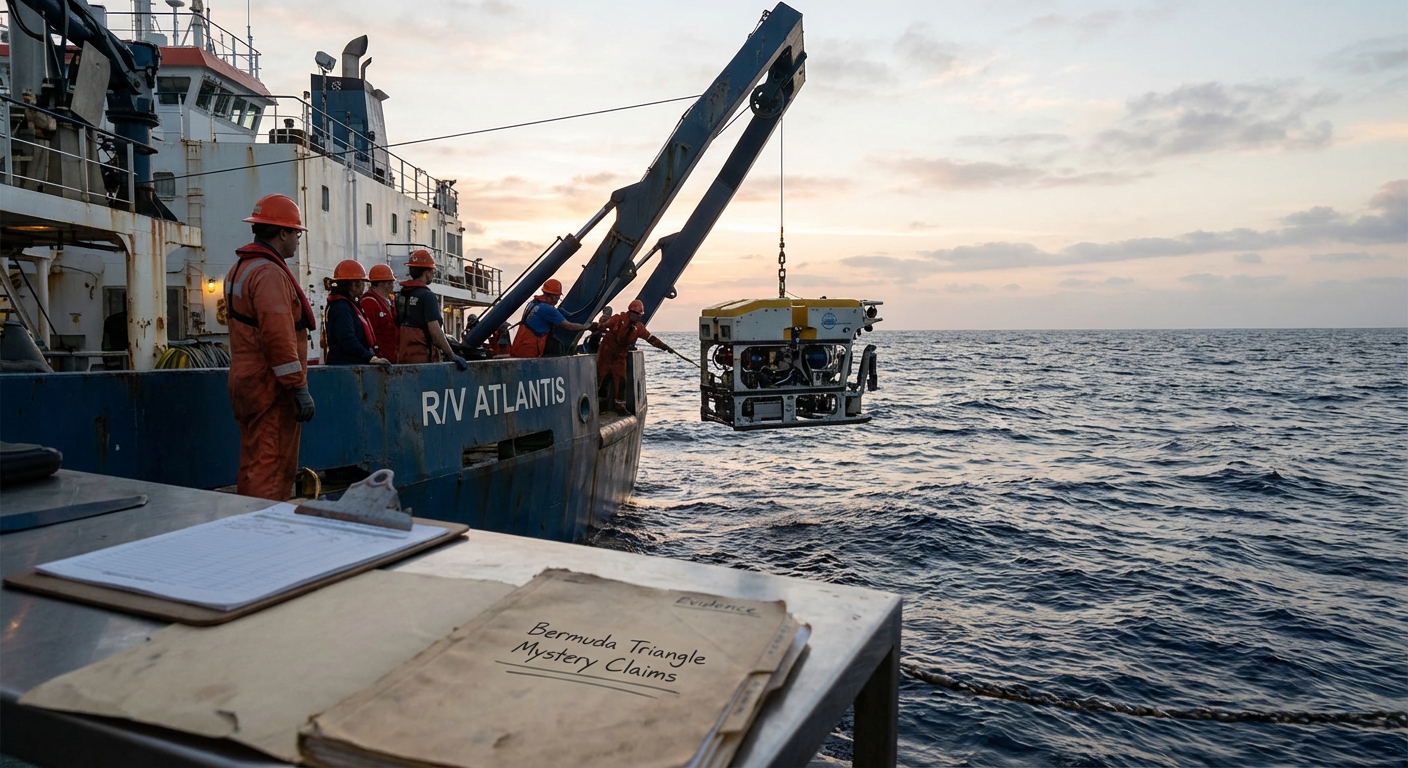
Below are the strongest arguments people cite in support of Bermuda Triangle mystery claims. This article treats those arguments as claims to be tested, not as established facts, and points to the primary types of evidence and verification tests researchers use to assess each one.
The strongest arguments people cite
-
Flight 19 — a group of five U.S. Navy TBM Avenger training aircraft vanished on December 5, 1945. Source type: U.S. Navy loss report / contemporary news accounts. Verification test: consult the Navy’s board-of-investigation records, radio transcripts, and contemporaneous search-and-rescue logs to verify what was recorded about compass failure, pilot radio calls, and the subsequent PBM search aircraft loss.
Why supporters cite it: the loss of multiple aircraft and one rescue plane with no recovered wreckage is presented as a classic unexplained incident. Official and archival records exist for researchers to inspect.
-
USS Cyclops — a large U.S. Navy collier disappeared with hundreds aboard on a voyage from Barbados to Baltimore. Source type: naval movement logs, shipping manifests, and contemporaneous communications. Verification test: review Navy logs, last known radio/telegraph messages, cargo manifests, and weather reports for the ship’s route to assess plausible mechanical, loading, or storm-related causes.
Why supporters cite it: no wreckage or distress call was found and it remains a large, historically documented disappearance. The primary documents and later historical summaries are available for review.
-
Apparent magnetic/compass anomalies and historical accounts (e.g., Christopher Columbus noting navigation oddities). Source type: ship logs, maritime reports, magnetic-variation maps, and historical journals. Verification test: compare contemporaneous navigation logs and modern geomagnetic data to determine whether compass variation or local magnetic anomalies could plausibly explain reported disorientation.
Why supporters cite it: compass errors can produce navigational disorientation at sea, and a handful of historical journals include ambiguous compass references — but the evidence must be checked against magnetic-deviation charts and original logs.
-
Methane-hydrate / gas-bubble hypotheses — large releases of methane from the seafloor could reduce water density and cause ships to lose buoyancy. Source type: geophysical studies, sediment cores, and oceanographic research. Verification test: search for geophysical evidence (sediment cores, seafloor mapping) showing past large methane eruptions at sites linked to specific disappearances; model the required gas volume to sink large vessels.
Why supporters cite it: this is an available scientific mechanism in other contexts, but direct evidence tying a specific disappearance to a methane event requires geologic data from the wreck site — data that, in most cases, do not exist.
-
Rapid weather changes, the Gulf Stream, and rogue waves — sudden storms, strong currents, and exceptionally large waves can wreck ships and down aircraft. Source type: meteorological records, oceanographic studies, and Coast Guard incident files. Verification test: check historical weather charts and contemporary meteorological analysis for the time and location of the incident; review search reports for evidence of weather-related loss.
Why supporters cite it: the area does see powerful storms and the Gulf Stream can rapidly disperse debris, which can make wreckage hard to find; such natural hazards are plausible, documented explanations for many losses.
-
Statistical / insurance anomalies — claims that shipping insurers (e.g., Lloyd’s of London) or loss statistics show elevated losses in the Triangle. Source type: insurance loss records, Lloyd’s analysis, and Coast Guard statistics. Verification test: obtain loss datasets for comparable ocean regions and compare incident rates per vessel-mile or flight-hour to determine whether the Triangle region shows an outlier rate.
Why supporters cite it: if losses were demonstrably higher, that would support the claim — but multiple investigators and insurance-market checks reported no statistical excess in the area. Researchers recommend direct analysis of Lloyd’s and Coast Guard records to confirm.
-
Eyewitness accounts of anomalous lights, “fireballs,” or sudden explosions (for example, observations connected to the PBM Mariner that launched to search for Flight 19). Source type: shipboard log entries, eyewitness testimony, and contemporaneous merchant-ship reports. Verification test: cross-check vessel sighting reports, tanker/ship logbooks, and official search logs to verify timing, location, and consistency of eyewitness claims.
Why supporters cite it: direct observations (if validated) can appear to point to an unusual event; but eyewitness reports often vary and must be corroborated by independent logs or physical evidence.
-
Popular books and magazine articles (Vincent Gaddis, Charles Berlitz, and others) that collected and emphasized unresolved cases. Source type: journalistic and popular nonfiction. Verification test: trace each cited incident to primary records (e.g., newspapers, naval files, weather records) to confirm whether the popular account accurately represented those sources.
Why supporters cite it: Gaddis’s Argosy article and Berlitz’s best-seller framed the narrative and listed incidents that, in many cases, became the core evidence people remember — but later researchers found errors and embellishments in several of these popular accounts.
How these arguments change when checked
The key pattern researchers report when claims are checked is: (1) many of the most-cited incidents are real historical losses, (2) popular retellings often omit weather, mechanical, or navigational evidence, and (3) authoritative agencies that maintain records do not find an anomalous loss rate in the region. NOAA’s ocean-service overview and the U.S. Coast Guard’s historical FAQ both conclude there is no evidence that disappearances occur at a higher rate in the Bermuda Triangle than in other busy ocean areas.
Examples from specific arguments above:
-
Flight 19: Archival Navy records show radio transmissions describing navigational confusion and later investigations attributed the most plausible cause to navigational error and fuel exhaustion for the training flight; the Navy’s handling of the written report also changed wording in later summaries, which fueled public controversy. That said, the absence of wreckage keeps the event partially unresolved at the level of physical confirmation. Researchers who reviewed the Navy board files and subsequent investigations have documented both the recorded radio calls and the limits of the search effort.
-
USS Cyclops: the ship’s disappearance is well documented in naval records, and historians and naval analysts have proposed plausible non-mysterious causes (structural failure under heavy cargo, storm conditions, or wartime hazards). However, because no wreckage has been located, the exact cause remains unproven, and the case is correctly listed by historians as an unresolved naval loss rather than proof of an exotic mechanism.
-
Methane, magnetic anomalies, and “rogue wave” explanations: these are physically plausible mechanisms in isolation — e.g., methane release can reduce water density in a localized plume and rogue waves can sink ships — but empirical linkage between those mechanisms and particular historic disappearances requires site-specific data that generally does not exist. NOAA and oceanographic literature note these mechanisms as hypotheses but emphasize that the pattern of the incidents is consistent with normal maritime hazards and human error.
-
Statistical/insurance claims: investigators (including reference researchers and insurance-market reviewers) have repeatedly found that the proportion of losses attributed to the region is not higher than might be expected given traffic volumes and the number of storms. Some of this work is summarized in skeptical analyses and in Larry Kusche’s detailed case-by-case research, which documented errors and exaggerations in many popular accounts. For a robust statistical test, however, one would need granular Lloyd’s/Coast Guard datasets and a defined geographic boundary — a difficulty because “the Triangle” has never had an official, universally agreed boundary.
Where sources conflict: interpretations diverge when (a) primary records are ambiguous or missing (e.g., no wreck field found), (b) secondary retellings include errors or selective omissions, and (c) a proposed physical mechanism (methane, magnetic anomaly) is plausible in principle but lacks direct site-specific evidence for a given incident. When there is genuine conflict between sources, the correct scholarly stance is to note the disagreement and stop at the limits of the documented evidence rather than to offer speculative causes.
This article does not attempt to resolve every case; it focuses on what type of evidence exists, how to test claims against primary records, and where the strongest documented gaps remain.
This article is for informational and analytical purposes and does not constitute legal, medical, investment, or purchasing advice.
Evidence score (and what it means)
- Evidence score: 22 / 100.
- Drivers: most high-profile incidents are historically documented (Flight 19, USS Cyclops), which gives a non‑zero baseline of verifiable records.
- Drivers: many popular secondary sources (magazine features, bestselling books) contain errors, exaggerations, or omissions; careful archival checks often reduce the strength of sensational claims.
- Drivers: authoritative agencies (NOAA, U.S. Coast Guard, U.S. Navy summaries) report no evidence of an elevated disappearance rate for the loosely defined region.
- Limitation: several individual losses lack wreckage or site-specific forensic data, which preserves genuine uncertainty for specific cases (notably USS Cyclops and Flight 19’s physical remains).
- Limitation: proposed exotic mechanisms (interdimensional vortices, Atlantis technology, extraterrestrials) have no empirical support in primary records and rely on rhetorical inference rather than testable evidence.
Evidence score is not probability: The score reflects how strong the documentation is, not how likely the claim is to be true.
FAQ
Do Bermuda Triangle mystery claims show more disappearances than other ocean areas?
No. Multiple authoritative reviews and the U.S. Coast Guard conclude that there is no evidence the region shows a higher rate of disappearances than comparable busy ocean corridors. NOAA’s ocean-service summary states explicitly that the available data do not support an anomalous disappearance rate. Researchers who have checked insurance and Coast Guard records have reached similar conclusions, though a definitive statistical paper comparing vessel- or flight-miles would require access to detailed loss and traffic datasets.
Are Flight 19 and the USS Cyclops explained?
Both incidents are historically documented and remain important elements of the Bermuda Triangle narrative. Flight 19’s archival records record radio calls consistent with navigational disorientation and the Navy’s investigation cited probable pilot error and fuel exhaustion, though no wreckage was recovered. USS Cyclops vanished without a trace and, while structural or cargo-related causes have been proposed, the absence of a wreck means the loss remains an unresolved naval disappearance rather than proof of an exotic mechanism.
What verification steps should a researcher take when evaluating a specific Bermuda Triangle claim?
Start with primary records: military or Coast Guard incident files, contemporaneous newspapers, ship logs, weather charts, and insurance-loss records. Verify dates, locations, and whether later sources changed or embellished facts. If a geophysical hypothesis is proposed, seek site-specific oceanographic or seafloor data. Where such primary evidence is missing, treat the claim as unresolved, not proven. Researchers who applied these steps (for example, Lawrence Kusche’s investigations) often found inaccuracies in popular retellings.
Why do Bermuda Triangle mystery claims persist if official agencies say there’s no anomaly?
Popular narratives are reinforced by selective retelling, memorable incidents (large losses or ambiguous radio calls), and bestselling books that grouped disparate cases into a single story. Psychological factors (preference for pattern, narrative framing, and the memorability of mysterious explanations) help the legend persist even when archival checks weaken specific claims. The phrase “Bermuda Triangle” itself was popularized by a 1960s magazine article and later amplified by books and documentaries.
Where can I read the primary sources mentioned here?
Useful starting points include NOAA’s ocean-service overview of the Bermuda Triangle, the U.S. Coast Guard historical FAQ, naval archival summaries and Navy History analyses for Flight 19, and detailed case-by-case research such as Larry Kusche’s investigations. For large‑scale statistical claims, researchers should seek Lloyd’s or comparable insurer loss databases and Coast Guard incident logs while defining a reproducible geographic boundary for analysis.

Science explainer who tackles space, engineering, and ‘physics says no’ claims calmly.